Aristotle_Altemps_Inv8575Writings on the different kinds of exchange can be traced back to Classical Antiquity. The Greeks were fascinated with markets, especially the ethical implications of such transactions, and soon began to formulate their  own opinions on the emerging markets in ancient Greece. Aristotle, especially, devoted some of his writing to understanding its complexity. He observed four types of exchanges in the developing market of Ancient Greece:

1.     C –> C ; where C = commodity

Better known as bartering, Aristotle had little issue with this mechanism of exchange in the market. He found it to be the most “natural” out of all exchanges, but saw major drawbacks in its inability in dealing with surpluses and deficiencies properly. The reason for exchange, from Aristotle’s understanding, was because an individual viewed the seller’s surpluses as being of higher value than his or her own surpluses, thus creating a transaction of equal value. He based the need for exchange around the concept of “use value” or “true value,” which a commodity holds if it is necessary for one’s life, household, or even community. He equated value with necessity. Therefore, Aristotle’s reasons for exchange can be seen as one of the early precursors the the subjective theory of value, since it acknowledges different use values for different households — based on their respective surpluses.

2.     C –> M –> C ; where M = Medium of exchange (i.e money)

The most prevalent method of exchange today — Aristotle was ambivalent to it. He found money to be necessary in establishing a common comparable measurement for all commodities in the market, however he also felt it facilitated the next two forms of exchange (3 & 4).  This particular transaction is very similar to barter in that the purpose of it is consumption. The use-value for each receiving end of the transaction is virtually the same, therefore the exchange is equal, with money serving as simply ameans, rather than as an end. Important to note also, is that Aristotle did not see money as a representation of value or wealth; it was a representation of want by agreement. Keep this in mind, because this is the one of the foundations for his criticism of the next two transactions.

The economy of Ancient Greece is useful to bear in mind when trying to understand Aristotle’s  analysis of markets. The majority of the work in Ancient Greek society was done by slave labor, mostly agricultural work, and many of the commodities on the market were products of individual artisans. Therefore, the full value was realized in its exchange of another commodity because the artisan’s sweat and work was fully accounted for in the transaction — the artisan kept all of what he produced, including his surpluses, and traded it likewise for a commodity of relatively equal value.

3.    M –> C –> Mp ; where Mp = M prime or M + profit

This mechanism of the market Aristotle found to be ethically problematic and abominable. He calls this retail trade and the issue, he felt, was that money served as a starting and end point of a transaction, rather than a medium of exchange. He also felt this violated the principle that market transactions should serve the needs of thehousehold, rather than succumbing to endless exchanges to increase profit. Aristotle did not consider this to be true wealth because the end goal is a greater quantity of money; it is simply a representation of exchange value in moneyed form — because it is purely qualitative, it lacks a limit, which was present in the first two kinds of market transactions. He believed there was no natural restrain on this form of transaction because the market exchange, in and of itself, was not entirely equal. In the first two methods of exchange, trade was limited to commodities that were produced by, presumably, individuals – therefore the starting point required an exertion of labor, and the transaction itself was virtually equal in its entirety. Because the starting point of this transaction, “M,” lacks that necessary productive capacity and because the individual is acquiring more of the same item he started with there is fundamentally no restriction on how much profit can be acquired — and the need to acquire more is intensified. Frankly, the major difference lies in that the first two transactions were to consume, this particular one is to accumulate.

4.      M –> Mp 

This market behavior is usually grouped with the third one shown, but Aristotle groups it differently because “C” is absent. He calls this usury, and the most unnatural of all market exchanges. He considered the reason for loans to be exploitative in that the giver of the loan was demanding higher returns than what was handed out — abusing the situation of the receiver of the loan.

Granted, there are issues with Aristotle’s understanding of basic market functions. The fourth market mechanism, in particular, is lacking in analysis — it fails to understand that that the interest payed back is a portion of the new productive potential that was created by that loan (i.e what it was put to use for, invested in, etc). Requesting a loan does not necessarily mean an individual is in distress, but since Aristotle was primary concerned with ethics, it is easy to see why he made that assumption. Aristotle’s fascination with ethics is also the driving reason he criticizes the moneyed interests driving the marketplace. His bare-boned economic analysis as an ethicist, albeit lacking in much empirical reasoning, does bring an important aspect of the market to light — the market is amoral. This is crucial. It is precisely due to this amorality, and because the market lacks any moral mechanisms and requirements, that the market sometimes succumbs to moneyed excesses of the socially damaging kind.
*** 
– Much of the information mentioned can be found in this article titled “Aristotle and Economics”
– More information on Plato’s and Aristotle’s economic views can be found here.

Of any movement, of any change, education is vital. It is the beginnings of new ideas, and it must be given special attention to ensure it is doing its proper purpose. However, the initial question is, what is the purpose of education? What does it mean to be educated? 

Today we are in an age where measure of achievement are standardized — a “one size fits all” approach to teaching and assessments. Divergent thinking is disregarded, and replaced with single-solution scenarios that involve little thought outside the limitations that are given to the pupils in the classroom. It turns education into a chore rather than a passion.

Granted, there are many reasons for this, but its primary reasons lie in its creation during the age of the Enlightenment and the Industrial Revolution. Fundamentally speaking, although the Enlightenment was a beautiful period of intellectual growth, it corresponded with the industrialization of much of the, then, “modern world.” Likewise, many of the concepts attributed to the industrial model were applied to education: standardization, divisions, and hierarchy. All of these functioned in the interests of industrialization, and in the image of it. Perhaps the most important externality that was brought the industrialized education, however, was a similar form of alienation. Specifically, the alienation of the pupil from the work he or she was creating in the classroom. It is this dilemma that cripples intuition and advancement, and rather makes students into pawns molded into a pre-manufactured consciousness. It is an impediment to growth. Even worse so, to think outside the realm of normal studies is downgraded and displeasing, because conformity and efficiency are key in an industrial model of practice.

Paulo Freire addresses these concerns in his masterwork “Pedagogy of the Oppressed,” and attempts to properly describe the educational system and articulate its flaws. He starts by categorizing the teacher-student relationship in dialectic terms, with a lack of real struggle.

“A careful analysis of the teacher-student relationship at any level, inside or outside the school, reveals its fundamentally narrative character. This relationship involves a narrating Subject (the teacher) and patient, listening objects (the students)…. education is suffering from narration sickness” [52].

Most importantly though, is the lack of significance in the teaching itself. The dialogue is hollow, and consists of “alienating verbosity.” It does little to motivate the students, and it furthermore categories them as objects ready to absorb what the instructor is telling them, without fruitful interaction; it teaches them little to nothing on the fluidity of history, making them cautious when witnessing change, and it does little to awaken the aspirations the pupils might have. The language lacks any transforming power, and learning becomes overly-mechanical rather than engaging.

“The teacher talks about reality as if it were motionless, status, compartmentalized, and predictable. Or else he expounds on a topic completely alien to th existential experience of the students” [52].

It is based on these observations that Freire theorizes on what he calls “the banking concept of education.”

“Education thus becomes an act of depositing, in which the students are the depositories and the teacher is the depositor. Instead of communicating, the teacher issues communiqués and makes deposits which the students patiently receive, memorize, and repeat. This is the “banking” concept of education, in which the scope of action allowed to the students extends only as far as receiving, filing, and storing the deposits” [53]. 

Bearing this mind, education must first solve this crux before it can go any further. The teacher-student contradiction must be properly handled before a true libertarian education can take root, that would eliminate the ignorance and encompass true transformation and radical praxis. Freire than goes on to delve into this contradiction, and I feel the quote deserves to be posted in full:

“The solution is not (nor can it be) found in the banking concept. On the contrary, banking education maintains and even stimulates the contradiction through the following attitudes and practices which mirror oppressive society as a whole.  

(a) the teacher teaches and the students are taught
(b) the teacher knows everything and the students know nothing
(c) the teachers thinks and the students are thought about
(d) the teacher talks and the students learn — meekly
(e) the teacher disciplines and the students are disciplined
(f) the teacher chooses and enforces his choice, and the students comply
(g) the teacher acts and the students have the illusion of acting through the action of the teacher(h) the teacher chooses the program content, and the students (who were not consulted) adapt to it
(i) the teacher confuses the authority of knowledge with his or her own professional authority, which she and he sets in opposition to the freedom of the students.
(j) the teacher is the Subject of the learning process, while the pupils are mere objects” [54].

This is the major issue, and the contradiction between the teacher-student relationship. For the commoners, education does little to change the condition which oppresses them, rather it only changes the consciousness of the oppressed. This is why the need for a radical new pedagogy is paramount — one that is free from the alienating aspects of industrialization, horizontal in its power structure, involving in its dialogue, and promoting of inquiry and understanding. In a proper educational setting, it is not only the student that learns; it is both the pupils and the teachers that intellectually grow. They expand on their knowledge through dialogue and conversation, thereby heightening their consciousness and crushing their once-held ignorance. This is the goal of radical education, of revolutionary pedagogy — the humanization and realization of one’s potential.

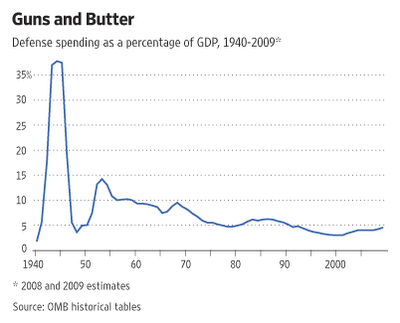
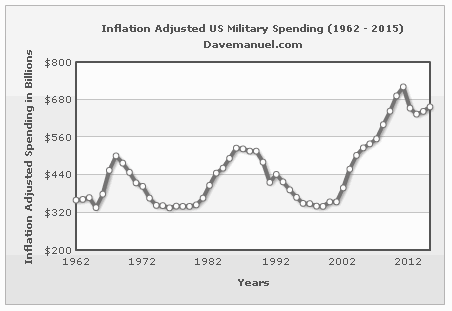
Since its creation, the United States has virtually been involved in perpetual war. Specifically speaking however, militarization has especially escalated, and remained high, since World War II.

As of 2011, according to the Stockholm International Peace Research Institute, the United States accounts for 41% of the world’s military spending — spending roughly 711 billion dollars, accounting for roughly 5% of GDP. These statistics are troubling as is, but perhaps even more troubling is the stranglehold the military has on the American economy. Let’s break down the facts, piece by piece.

  • More than one-third of all scientists and engineers are engaged in military related jobs [Sato, 8].
  • Many industrial sectors are intertwined with military spending, the main two being aerospace and shipbuilding [Sato, 8].
  • Shipbuilding is heavily dependent onmilitarization. In 2002, shipbuilding brought in 11 billion in profits — only 3.8 billion of this was from commercial shipbuilding [SCA, 1].
  • In total, based on 2001 data, the top 11 aerospace and defense corporations employ over 900,000 people [Sato, 9]. This number can only be assumed to have increased since the Afghanistan and Iraq wars.
  • War-profiteering is high, especially in the last decade. To name one, Halliburton’s KBR, Inc. division profited $17.2 billion from the Iraq War during 2003-2006 alone. More information can be found here.
  • The arms trade in the United States is a multi-billion dollar industry. It accounts for roughly 39% of the total world market, ranking in 170 billion dollars from ’03 to ’10.
  • The top sellers are ironically 5 permanent members of the UN security council; U.S, France, China, Russia, and the UK. The majority of the buyers are developing nations.
  • Many U.S taxpayer subsidies go toward the arms trade as well.

The United States is also a main supplier of foreign aid to other nations, especially military aid. As of 2010, much of it is allocated to Israel and Egypt.

  • Israel was given 3.2 billion U.S dollars in 2010, while Egypt was given 1.6 billion. However, there is little consistency; West Bank/Gaze was given 69 million in aid and other Middle Eastern states are given upwards of 100s of millions of dollars to essentially “leave Israel alone.”
  • Certain regions also are heavily funded. 3.3 billion U.S dollars were allocated, for example, to South and Central Asia, however that is minuscule to the total combined amount given to Egypt and Israel.
Based on 2007 statistics
As percent of federal spending (2007)

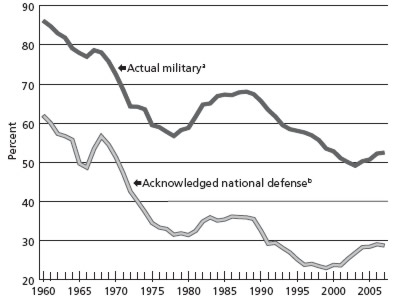
The issue with looking at American military spending is that much of it is withheld and convoluted. When military space expenditures, veteran payments, foreign aid, and other military-related costs are added in, the total actual budget is much higher than what was mentioned earlier in this post — surpassing 1 trillion U.S dollars. Moreover, the percentage of federal spending is also misleading if taken at face value; it also includes transfer payments, such as social security and medicare, which are self-financed and do not use income tax revenue. The actual military spending curve shown to the right takes this into consideration. Keeping this in mind, GDP and budget percentages soar to shocking levels.

Equally disheartening, though, is the effect this has had on poverty in the United States. There is a correlation, in recent years, to war spending and individuals living under the poverty threshold.

Fundamentally, this all of this is a reason for concern. With the United slipping from the economic dominance it once had, will it be forced to resort to military bullying to stimulate its industrial sectors and to maintain its intentional prestige? Although high military spending has been a staple in American policy for decades, it has spiked in recent years — and since the Cold War and the fall of the Soviet Union, the political machine is promoting it quite overtly since now it has little reason to hide. Frankly, using militarism to promote imperial ends must cease — there is much blood on American hands, and fostering success through war is both inhumane and unsustainable. All great empires collapse by overreaching its boundaries, due to excessive military budgets and overly-ambitious expansionist interests. The United States is on the path to be doomed to a similar fate if this jingoistic culture persists.

***


– Sato, Eiko. Culture of Peace: Rediscovery of Human Innate Potential and Capability for Peacefulness: Culture of Peace and Violence in the United States. Honolulu: University of Hawaii Library, 2005. Web.
– Shipbuilders Council of America. Economic Contribution of U.S Commercial Shipbuilding Industry. Washington D.C: , 2002. Web. 
– The actual military figures were acquired from an article titled “U.S Imperial Triangle and Military Spending” from the Monthly Review.
– The written manuscript of Martin Luther King Jr.’s speech titled “Why I am Opposed to the War in Vietnam.”
– A relevant article that provides more insight: U.S Military Industrial Complex: Profiting from War

Work is difficult to define. In the modern mindset, it has become synonymous with economic productivity — a primary cornerstone to progressing society: a kind of necessary evil.

Fundamentally, however, work does not implicitly have a negative connotation. Contrary to its function in today’s modern context, work is not objectively a burden nor a pleasure; It simply is. Work is indeed a necessity, that much is true, but must work be pursued and viewed as solely a negative aspect of one’s lifestyle and be downgraded to the point of dissatisfaction, hatred, and dissuasion? Yugoslav Marxist-humanist Mihailo Marković, in his philosophical work titled “From Affluence to Praxis” addresses this dilemma:

“Work is a neutral concept. It refers to an activity which is a necessary condition of human survival and development in any type of society” [65].

The indispensable nature of “work” is crucial to the praxis of Marxism. The elimination of the “free rider” issue is a paramount dilemma, and has to be properly discussed before goods are allocated accordingly. Specifically speaking, this requires a clear correlation between work done and goods received to be able to function fairly; however, the proper criteria and definition of work must be defined for such concepts to be handled.

The initial question that must be answered is — what is work, and how is it different from labor? Marković makes a stark distinction:

“In labor the worker uses only those abilities and skills which he can sell, which are needed in the process of commodity production… [Work] is the permanent exchange of matter with nature” [63].

“[Work] is the self-realization and satisfaction of human needs… [labor] might be maximization of income, or increase of power” [66].

Perhaps most importantly, work is a natural concept. It is not, by nature, exploitative nor negative. Only in the current mechanisms of the market, is “work” (better said as labor) defined by its productive forces — by its potential to produce more capital and profit. Realistically speaking, virtually all action that progresses the social being is work once this chained view of labor is broken. Leisure, which is seen as an valueless in economic terms, is indeed a form of work. It is used as an outlet to break from the routine of labor that is a commonplace in today’s age of modernity; an attempt to free oneself from the objectification of what he does.

The largest obstacle to the realization of pure work, the fullest self-realization and satisfaction of human needs, is the alienating nature of today’s labor. Marković defines it quite well:

“Alienated labor is the activity in the process of which man fails to be what he is, that is, fails to actualize his potential capacities and to satisfy his basic needs. Marx distinguished the following four dimensions of this type of alienation: (a) One loses control over produced commodities. The blind forces of market enslave man isnterad of being ruled by him. (b) In his struggle for more property and power man becomes estranged from his fellow man. Exploitation, envy, mistrust, competition, and conflict cominuate relationships among individuals. (c) Instead of employing his capacities in creative, stimulating work, man becomes an appendage of the machine, a iving tool, a mere object. (d) As no opportunity has been offered to him to fulfill his potential abilities, to develop and satisfy various higher-level needs, his whole life remains poor, one-sided, animal-like, his existence remains far below the real possibilities of his being” [63]. 

Although poetic in its definition, it is fundamentally true. Is it not human to become more inclined to work, if one feels involved in the final product? Is one not more inclined to work if he feels it is necessary for the community, which he has clearly learned, through praxis, that it likewise benefits him as well? The struggle, then, is to liberate work from being a status of wealth and power. Rather, it should be seen as a necessity for human conditioning and improvement. “Work” is not simply a commodity to be used and exhausted, to be stripped of creative spirit; it is has definite aesthetic qualities. If one realizes the beauty in work, the individual is more inclined to work to reach the means that was once outside its productive sphere. Work would develop beyond being a collection of one-sided mundane tasks for indefinite periods of time; it would serve as a necessary form of expression of one’s abilities and talents.

***
Labor’s Struggle for Supremacy by Eugene V Debs.
The Right to be Lazy by Paul Lafargue

pedagogy_of_the_oppressedThere is so much to say about Paulo Freire masterwork Pedagogy of the Oppressed. It’s direct, it’s unrepentant in its criticisms, and it’s eloquent in its message. It captures the essence of the oppressor-oppressed relationship, attempting to circumscribe such an abstract struggle onto paper — and Freire manages to do so, quite well. The main dilemma when writing a book of this nature is that the woes of the oppressed must be properly synthesized into one concrete message in order to be discussed in any real detail. The biggest issue is that the struggle, in itself, is both metaphysical and material. It requires a look at the cognitive ramifications of being oppressed, as well as the causes of them; all in an effort to analyze the strife from a truly introspective perspective, one that virtually enters the minds of those under oppression. It is because Freire’s magnum opus is able to successfully incorporate these concepts, it is able to transcend far beyond being just a mere analytic Marxian study — it becomes a riveting testament to those involved in the actual struggle, rather than being just a vague documentation of what their ills are. This makes it all the more powerful and enlightening. However, because it is so vast in its message, I’ll contain my comparatively brief analysis to the first chapter only.

Paulo Freire, throughout the entire work, makes an effort to textually encapsulate the meaning of “humanization” and he revolves much of his analysis on “re-humanizing” the human spirit.

“But while both humanization and dehumanization are real alternatives, only the first is the people’s vocation… It is thwarted by injustice, exploitation, oppressed, and the violence of the oppressors; it is affirmed by the yearning of the oppressed for freedom and justice, and by their struggle to recover their lost humanity” (26). 

However, he is careful in noting who must lead this liberation.

“In order for this struggle to have meaning, the oppressed must not, in seeking to regain their humanity (which is a way to create it), become in turn oppressors of the oppressors, but rather restorers of the humanity of both. This, then, is the great humanistic and historical task of the oppressed: to liberate themselves and their oppressors, who oppress, exploit, and rape by virtue of their power, cannot find in this power the strength to liberate either the oppressed or themselves. Only power that springs from the weakness of the oppressed will be sufficiently strong to free both” (27).

With this, Freire makes a monumental point that has been historically validated time and time again. The greatest issue with any revolutionary struggle is dealing with the vacuum of power, which plagued the leftist vanguard experiments of the 20th century. The key point being: power cannot concentrate and cannot be exerted to form a new “ruling class” of privilege and wealth — that would be the antithesis of any liberating movement, and would be a perversion of the humanization that was hoped to be achieved.

However, an issue arises (out of many) when attempting to foster such a radical change. The oppressed must realize the necessity to fight for it. The spark must be lit, but that must correspond with the oppressed realizing their downtrodden status. They must be lifted from their anesthetized state, by their own volition, and must be free of “their submersion in the reality of oppression” (27). Oftentimes, the downtrodden simply strive to become part of the higher class, in an effort to alleviate their poor condition, since they have been convinced it is the only way to move upward. They become fearful of greater repression to take action.

“… [the oppressed] have no consciousness of the themselves as persons, or as members of an oppressed class. It is not to become free that they want agrarian reform, but in order to acquire land and this become landowners — or, more precisely, bosses over other workers. It is a rare peasant who, once “promoted” to overseer, does not become more of a tyrant towards his former comrades than the owner himself. This is because the context of the peasant’s sitatuion, that is, opression, remains unchanged. In this example, the overseer, in order to make sure of his job, must be as tough as the owner — and more so… during the initial stage of their struggle the oppressed find in the opressor their model of ‘manhood'” (28). 

The oppressed must overcome this personal struggle before he strives for anything, that much is crucial. He must learn to accept freedom, and to cherish it, rather than take the position of his former boss or owner. He must not be fearful of real change.

“This fear of freedom is also to be found in the oppressors, though, obviously, in a different form. The oppressed are afraid to embrace freedom; the oppressors are afraid of losing the ‘freedom’ to oppress” (28). 

“…the oppressed, having internatlized the image of the oppressor and adopted his guidelines, are fearful of freedom. Freedom would require them to eject this image and replace it when autonomy and responsibility… Freedom is not an ideal located outside of man; nor is it an idea which becomes myth. It is rather the indispensable condition for the quest for human completion” (29).

“…at a certain point in their existential experience the oppressed feel an irresistible attraction towards the oppressors and their way of life. Sharing this way of life becomes an overpowering aspiration. In their alienation, the oppressed want at any cost to resemble the oppressors, to imitate them, to follow them. This phenomenon is especially prevalent in the middle-class…” (44). 

Bearing this in mind, it becomes apparent that, first and foremost, reflection is essential to action. The goal is not to simply engage in dialogue with the masses, but to transform them in an effort to have them fight for their own liberation. It is this crucial step that will ultimately end their alienation. The difficulty, then, is how to go about doing so in a fashion that differentiates itself from the elusive efforts of the“humanitarian” oppressors.

“Pedagogy which begins with the egoistic interests of the oppressors (an egoism cloaked in the false generosity of paternalism) and makes of the oppressed the objects of its humanitarianism, itself maintains and embodies oppression. It is an instrument of dehumanization. That is why… the pedagogy of the oppressed cannot be developed or practiced by the oppressors. It would be a contradiction in terms if the oppressors not only defended but actually implemented a liberating education” (36). 

Simply put, by making the oppressed the objects of humanitarianism, you are in effect dehumanizing them — you are leaving them in the same situation with produced them and fooling them with false gestures of generosity, which do little to fundamentally alleviate the ills they have grown accustomed to and inherited.

In order to fully articulate this message, you first have to clean up the semantics of certain terms to be able to even speak properly and understood in any reasonable context. The most important term that must be attended to is the definition of oppression. Oftentimes, the term is thrown around to describe the nature of egalitarianism; that equality is also oppression, since hierarchy is prevented through“force.” Paulo Freire actually addresses this misguided criticism:

“Resolution of the oppressor-oppressed contradiction indeed implies the disappearance of the oppressors as the dominant class. However, the restrains imposed by the former oppressed on their oppressors, so that the latter cannot reassume their former position, do not constitute oppression. An act is oppressive only when it prevents people from being more fully human. Accordingly, these necessary restraints do not in themselves signify that yesterday’s oppressed have become today’s oppressors. Acts which prevent the restoration of the oppressive regime cannot be compared with those which create and maintain it, cannot be compared with those by which a few men and women deny the majority their right to be human” (38).

Freire then goes on to describe the oppressors, and defining the class associated with that term. The quote itself is too long to post here (it surpasses a page of very concise text, and is elaborated on later in his the work), but there are a few stand-alone points that are worth reiterating.

“For [the oppressors], to be is to have and to be the class of the ‘have'” (40).  

“The oppressor consciousness tends to transform everything surrounding it into an object of its domination. The earth, property, production, the creations of people, people themselves, time — everything is reduced to the status of objects at its disposal” (40). 

He then delves into the destructive self-depreciating impact this has on the oppressed:

“If [the oppressed] do not have more, it is because they are incompetent and lazy, and worst of all is their unjustifiable ingratitude towards the “generous gestures” of the dominant class. Precisely because they are ‘ungrateful’ and ‘envious,’ the oppressed are regarded as potential enemies who must be watched” (41). 

This is perhaps the root of Marxian alienation; it is this mentality that limits the human spirit and degrades the mind. The oppressed become convinced of their own unfitness.

Paulo Freire ends this dense chapter on the proper method of liberating the oppressed. He differentiates two different transformations: those that are for the oppressed and those that are with them — the latter being the valid one, which demands more than mere propaganda and simple populism. The struggle cannot be done for them, rather it must be done with them. It requires pedagogical action.

“They must realize that they are fighting not merely for freedom from hunger [or any other individually specific issue], but for the freedom to create and to construct, to wonder and to venture” (50).  

And perhaps most importantly:

The oppressed have been destroyed precisely because their situation has reduced them to things. In order to regain their humanity they must cease to be things and fight as men and women. This is a radical requirement. The cannot enter the struggle as objects in order later to become human beings” (50).   

Therefore, with these requirements in mind, it becomes apparent that the struggle demands committed involvement and an elimination of the cultural hegemony that preceded it. This must be done through a radical pedagogy, one that is lead by the oppressed. That is the synopsis of the message in Pedagogy of the Oppressed —that liberation, the humanization of human aspirations, can only come from the commoners themselves.

Senator Daniel Webster, one of the Great Triumvirate.

The War of 1812 was a brutal conflict between the infantile United States and the British Empire, and the culmination of years of unsettled dues from the Revolutionary War. The first real test of power since its independence, aside from the Barnaby Wars, the United States was faced with a dilemma; they lacked the proper ground troops to deal with such an impending crisis from the British Crown. Scrambling for solutions, then-president James Madison sought advice from his Secretary of State James Monroe who then pitched in his two cents — instate a national draft of 40,000 men. It was this proposal that Senator Daniel Webster fiercely criticized on the House floor in his December address during the winter of 1815. His words are perhaps one of the most eloquent defenses I have read against conscription. Here’s some food for thought:

“…Is this, Sir, consistent with the character of a free Government? Is this civil liberty? Is this the real character of our Constitution? No Sir, indeed it is not. The Constitution is libelled, foully libelled. The people of this country have not established for themselves such a fabric of despotism. They have not purchased at a vast expense of their own treasure and their own blood a Magna Carta to be slaves. Where is it written in the Constitution, in what article or section is it contained, that you may take children from their parents, & parents from their children, & compel them to fight the battles of any war, in which the folly or the wickedness of Government may engage it? Under what concealment has this power lain hidden, which now for the first time comes forth, with a tremendous & baleful aspect, to trample down & destroy the dearest rights of personal liberty? Who will show me any constitutional injunction, which makes it the duty of the American people to surrender everything valuable in life, & even life itself, not when the safety of their country & its liberties may demand the sacrifice, but whenever the purposes of an ambitious & mischievous Government may require it? Sir, I almost disdain to go to quotations & references to prove that such an abominable doctrine has no foundation in the Constitution of the country. It is enough to know that that instrument was intended as the basis of a free Government, & that the power contended for is incompatible with any notion of personal liberty. An attempt to maintain this doctrine upon the provisions of the Constitution is an exercise of perverse ingenuity to extract slavery from the substance of a free Government. It is an attempt to show, by proof & argument, that we ourselves are subjects of despotism, & that we have a right to chains & bondage, firmly secured to us & our children, by the provisions of our Government. It has been the labor of other men, at other times, to mitigate & reform the powers of Government by construction; to support the rights of personal security by every species of favorable & benign interpretation, & thus to infuse a free spirit into Governments, not friendly in their general structure & formation to public liberty.”

He goes on to articulate the gruesome effects of the war on families and lives:

“…Sir, I invite the supporters of the measures before you to look to their actual operation. Let the men who have so often pledged their own fortunes & their own lives to the support of this war, look to the wanton sacrifice which they are about to make of their lives & fortunes. They may talk as they will about substitutes, & compensations, & exemptions. It must come to the draft at last. If the Government cannot hire men voluntarily to fight its battles, neither can individuals. If the war should continue, there will be no escape, & every man’s fate, & every man’s life will come to depend on the issue of the military draught. Who shall describe to you the horror which your orders of Conscription shall create in the once happy villages of this country? Who shall describe the distress & anguish which they will spread over those hills & valleys, where men have heretofore been accustomed to labor, & to rest in security & happiness. Anticipate the scene, Sir, when the class shall assemble to stand its draft, & to throw the dice for blood. What a group of wives & mothers, & sisters, of helpless age & helpless infancy, shall gather round the theatre of this horrible lottery, as if the stroke of death were to fall from heaven before their eyes, on a father, a brother, a son or an husband. And in a majority of cases, Sir, it will be the stroke of death. Under present prospects of the continuance of the war, not one half of them on whom your conscription shall fall will ever return to tell the tale of their sufferings. They will perish of disease & pestilence, or they will leave their bones to whiten in fields beyond the frontier. Does the lot fall on the father of a family? His children, already orphans, shall see his face no more. When they behold him for the last time, they shall see him lashed & fettered, & dragged away from his own threshold, like a felon & an outlaw. Does it fall on a son, the hope & the staff of aged parents. That hope shall fail them. On that staff they shall lean no longer. They shall not enjoy the happiness of dying before their children. They shall totter to their grave, bereft of their offspring, & unwept by any who inherit their blood. Does it fall on a husband? The eyes which watch his parting steps may swim in tears forever. She is a wife no longer. There is no relation so tender or so sacred, that, by these accursed measures, you do not propose to violate it. There is no happiness so perfect, that you do not propose to destroy it. Into the paradise of domestic life you enter, not indeed by temptations & sorceries, but by open force & violence.”

Powerfully speaking, he once again affirms the principles of a free society:

“…In my opinion, Sir, the sentiments of the free population of this country are greatly mistaken here. The nation is not yet in a temper to submit to conscription. The people have too fresh & strong a feeling of the blessings of civil liberty to be willing thus to surrender it. You may talk to them as much as you please, of the victory & glory to be obtained in the Enemy’s Provinces; they will hold those objects in light estimation, if the means be a forced military service. You may sing to them the song of Canada Conquests in all its variety, but they will not be charmed out of the remembrance of their substantial interests, & true happiness. Similar pretences, they know, are the graves in which the liberties of other nations have been buried, & they will take warning. Laws, Sir, of this nature can create nothing but opposition. If you scatter them abroad, like the fabled serpents’ teeth, they will spring up into armed men. A military force cannot be raised, in this manner, but by the means of a military force. If the administration has found that it cannot form an army without conscription, it will find, if it ventures on these experiments, that it can not enforce conscription without an army. The Government was not constituted for such purposes. Framed in the spirit of liberty, & in the love of peace, it has no powers which render it able to enforce such laws. The attempt, if we rashly make it, will fail; & having already thrown away our peace, we may thereby throw away our Government.”

Part of the Great Triumvirate of the Senate, Daniel Webster could not have used his talent of speaking more masterfully.

The election of 1864 was one of bitter divides. In a strategic effort to garner nonpartisan support, Lincoln attempted to appeal to the splintered Democratic Party where there was a rift between War Democrats and the Copperheads (anti-war Northerners). He ran under the “National Union Party,” in an effort to show American unity during a time of severe crisis and chose Andrew Johnson, a War Democrat, as his running mate. They would go on the capture the imagination of the North, winning the election of 1864 in a landslide against former General George B. McClellan who was running on the Democratic ticket.

Shortly after the election victory, an uncanny letter was handed to U.S Ambassador Charles Francis Adams with the instructions being that it be given to newly-elect, Abraham Lincoln. It was from the First International, and it was written by Karl Marx himself, congratulating Lincoln’s efforts during the United States’ time of war. It was praising and optimistic of the future of labor in the United States. It read:

We congratulate the American people upon your re-election by a large majority. If resistance to the Slave Power was the reserved watchword of your first election, the triumphant war cry of your re-election is Death to Slavery.

Marx goes on to further show eloquently his sincere support and bright anticipation of the workers’ future:

While the workingmen, the true political powers of the North, allowed slavery to defile their own republic, while before the Negro, mastered and sold without his concurrence, they boasted it the highest prerogative of the white-skinned laborer to sell himself and choose his own master, they were unable to attain the true freedom of labor, or to support their European brethren in their struggle for emancipation; but this barrier to progress has been swept off by the red sea of civil war. The workingmen of Europe feel sure that, as the American War of Independence initiated a new era of ascendancy for the middle class, so the American Antislavery War will do for the working classes. They consider it an earnest of the epoch to come that it fell to the lot of Abraham Lincoln, the single-minded son of the working class, to lead his country through the matchless struggle for the rescue of an enchained race and the reconstruction of a social world.

It becomes apparent from this writing that Marx understood the dilemma of the laborers in the United States. Divided between racism, a blemish that became more visible during the eve of the Civil War, the working class was unable to mobilize. They lacked the capacity in numbers and in heart – being divided by systemic racial scapegoating that pitted them against their fellowman. Karl Marx even directly mentions this in his book ‘Das Capital.’ He writes:

In the United States of North America, every independent movement of the workers was paralysed so long as slavery disfigured a part of the Republic. Labour cannot emancipate itself in the white skin where in the black it is branded.

It would be naive for anyone to believe that liberation and class struggle could properly take place with the institution of slavery still intact. Marx fully understood this. He considered it a necessary step in bourgeoisie history for it to be abolished; it being a vital precursor to real proletariat efforts.

A reply to the commemorative letter from Marx was actually given by Ambassador Adams in January of 1865. Seemingly, Lincoln enjoyed the warm support he received from the First International:

So far as the sentiments expressed by it are personal, they are accepted by [President Lincoln] with a sincere and anxious desire that he may be able to prove himself not unworthy of the confidence which has been recently extended to him by his fellow citizens and by so many of the friends of humanity and progress throughout the world.

The rest of the response goes on to espouse a surprisingly internationalist tone:

Nations do not exist for themselves alone, but to promote the welfare and happiness of mankind by benevolent intercourse and example. It is in this relation that the United States regard their cause in the present conflict with slavery, maintaining insurgence as the cause of human nature, and they derive new encouragements to persevere from the testimony of the workingmen of Europe that the national attitude is favored with their enlightened approval and earnest sympathies.

It was perhaps, in this reply and in the events unfolding, the First International saw a glimmer a hope for the emancipation of the laborers in the United States. It was the start of a new ‘epoch,’ as they call it, but however it is disheartening to note that Marx wrote little to nothing on the events that would follow during the Reconstruction. He turned his attention elsewhere, abandoning the struggle in the Western Hemisphere and instead turning to a more Eurocentric revolutionary approach – which was perhaps a mistake in and of itself.

Despite this, a portion of Marx’s predictions came true. There was indeed a shift in the workers’ mentality in the decades after the Civil War. The National Labor Union (NLU), founded in 1866, was the first national labor organization in the United States. Many such organizations formed likewise in the age of railroad tycoons, demanding higher wages and shorter hours. The telling revelation here is that, when compared to the building of the canals during the decades after the turn of the 19th century, the consciousness of the workingman changed. Over a thousand men died from swamp fever during the construction of the Eerie Canal, but little to no backlash followed. Many more worked long and difficult hours on similar projects during that time, but there were no strikes nor was there much violence. This only changed after the institution of slavery was abolished. Marx’s optimism was therefore fulfilled, in some respects; The emancipation of slaves also emancipated the rest of the United States – in body and in mind. Frankly, although some initial momentum was lost after Reconstruction ended, it heightened the peoples’ sensitivity to their impoverished state with which they responded by organizing – such that would be violently repressed years later during the wealth-concentrated time of the Gilded Age, where money was the utmost desire and politics was the wealthy man’s game.

***

– The First International Letter to Lincoln, and the response, can be found here.
– More writing by Marx on the Civil War can be found here.
– Also, a letter exchange on this topic in the Fourth International (2009) can be found here.
– And finally, here is an interesting article from International Socialist Review where they analyze Lincoln from a Marxist perspective.

Note: Be sure to read part one first to understand this article in its full context.


There a two phenomena when addressing private ownership that are absent form Hardin’s famous article “The Tragedy of the Commons.” Most of them are intertwined with general criticisms of the capitalist structure, but they also specific criticisms of Hardin’s theoretical narrative.

For one, there have been innumerable examples of private rightsholders preventing a socially wanted outcome. Because each individual is working for his own pursuits, communal interests are excluded from the profit equation causing inherent inequity. This particular feature of private accumulation of capital and land has been called “The Tragedy of the Anti-Commons” and it is essentially the antithetical variant to Hardin’s proposed scenario; it is when private individual ownership hinders the common good. Private owners essentially hurt the majority for their own individualistic ends, which is an incentive created only by the dollar motive. Such an outcome, I would argue, has been seen in much of the Third World with foreign ownership of resources. Arable land, oftentimes unused, is bought up by foreign investors, which strips the locals from share of their own resources. In Argentina, to take one example, foreign ownership owns about half of all land that can be used to grow crops. I’ve already talked about this in depth already in another post, so I won’t go into it again, but more info on the inequity of land ownership in South American be found here and here.

The nature of this unequal distribution, which hurts the townsfolk of these regions, is a direct product of profit-drive economy and a privatized market structure because the encouragement to go far and beyond to acquire foreign assets would not exist without it. This, I would argue, is the tragedy; the taking of land for the sole purpose of wealth accumulation and hurting the impoverished regional majority in the process.Another phenomenon is something that some have called “The Comedy of the Commons,” a ‘parody’ of Hardin’s original assumption. It is when all of Hardin’s absurd assumptions are found, but the outcome he predicts still does not occur. However, such an example is absent from the real world because his scenario is strictly an abstract concept. It does not pertain to the material; however, there have been examples in the virtual where value has actually increased with an open communal setting.Wikipedia is a perfect example of this, and any online database or forum that is open to individual input. Anybody can use the information, but its value and database only increases with more communal activity and contribution. This begs the question; Why are individuals driven to contribute to a network or open system when they gain no monetary compensation? It seems that human action is driven by more than profit, especially in academia, where no worth can artificially be put on the pursuit of knowledge. It is this that privatization fails to compensate for; that ideas are invaluable ‘commodities.’ The downgrading of the humanities and others areas of academia are a perfect testament to this. Once you reach the area of intellectual thought, the price-determining element of capitalism seemingly cannot put a monetary number on it. This most certainly dissuades individuals wishing to pursue these respective fields, because now they are forced to fundamentally reshape their aspirations to be paid a better wage to live. I find this immensely limiting to the human spirit and mind, and it is incredibly dehumanizing to an intolerable degree.
***


A general article on the Tragedy of the Anti-Commons can be found here. It discusses the under-usage of resources with many private owners, completely undermining the “efficiency of the market.” And here is an informative video on what motivates us, which especially pertains to academia.

In 1968, Garrett Hardin posted an article in the magazine Science called “Tragedy of the Commons” and it was an attempt at proving that private property was the most efficient method of rationing goods and maintaining resources efficiently. It is oftentimes used in arguments favoring the privatization of common resources. His theoretical scenario was as follows:

There is a plot of land in the middle of a small peasant town. The plot of land is commonly owned, and is used for grazing; it is open to anybody that wishes to send their cattle there. Each peasant owns livestock and must use that land to feed their livestock. Knowing that each individual wants to maximize what they can get from the fertile acreage, each peasant brings as many animals as they can to the pasture, therefore, ruining the pasture for everyone. This is what Hardin calls ‘the tragedy.’ Each peasant wants to maximize their ‘grazing’ because they knew that if they don’t, somebody else would. Garrett Hardin calls this outcome “inevitable,” which he says makes it all the more tragic. He goes on to say there are two possible solutions to prevent such an outcome: either through regulation by an overseeing government body or through privatization of the common pasture so each peasant is responsible for his or her piece of land.

The original article from 1968 can be found here. And here’s a corresponding video with Garrett Hardin talking about his scenario.

Now, there’s a few issues that arise when Hardin’s scenario is contested in a real world environment. He makes three assumptions that do not stack up to what actually happened in the famous commons of England and elsewhere. They are as follows:

1. Each individual is working to maximize his or her profit.
2. The peasants do not communicate with one another.
3. That the pasture is open for anybody to use freely.

What actually happened in the commons of England, where the peasants lived after being freed from the shackles of feudalistic rule, was very different than Hardin describes. In these small villages, these commoners were very careful not to abuse the land that they had because they knew if they did the entire community would starve. The communicated with one another to prevent such happenings, and overgrazing was for the most part prevented. And since they were not functioning in a money economy, by growing their own food, they had little incentive to grow beyond what they needed – and if more was grown it was for surplus in case of shortages. And finally, these pastures were not open to everyone; it was established by common law, assumed through interaction, that the land was to be used only by those that have agreed to take care of it. Essentially, it was to be used only by the peasants living in the village itself.

Common grazing areas for livestock were a commonplace from the Middle Ages until the beginnings of the modern era. Farms were oftentimes broken up into three sections; one for wheat, one for barley, and one for grazing. This three-section open field was popular even after feudalism collapsed, until the advent of a market economy which specifically required the enclosure of common pastures. So the tragedy Garrett Hardin actually describes was seemingly backwards; rather than privatization of the commons being the solution to overgrazing, it became the tragedy itself.
Gilbert Slater, a British economist and social reformer, wrote a book in 1907 titled “The English Peasantry and the Enclosure of Common Fields.” He describes the coercive methods of enclosure:

Enclosure of the common fields, meadows and pastures, of

any particular village may have taken place in the following
ways : —

(1) By Act of Parliament, viz., (a) by a private Act, (b) under
the authority of the General Enclosure Acts of 1830 and 1836,
(c) by the Enclosure Commissioners and their successors, the
Board of Agriculture, under the General Enclosure Act of 1845
and its amending Acts.
(2) By common agreement of all the collective owners.
(3) By the purchase on the part of one owner of all conflicting
rights.
(4) By special licence of the Tudor monarchs.
(5) By various forms of force and fraud.

Commonable waste may have been enclosed in any of the
above ways, and also under the Statutes of Merton and Win-
chester (1235 and 1285), which give Lords of the Manor the right
of enclosing commons provided proof is given that the tenants of
the manor are left sufficient pasture.

Specifically speaking, the most devastating were the Inclosure Acts passed by the Parliament of the United Kingdom that stripped away the rights of common ownership from the local peoples by government force. This completely replaced the common law once understood by the peasant class, and put in its place a codified method of enclosure that many of the poor farmers did not agree to – this was mostly because many were illiterate and did not understand (for the most part only the nobles were educated).

A 17th century poem fully describes the real tragedy this caused to the local folk:

The law locks up the man or woman
Who steals the goose from off the common
But leaves the greater villain loose
Who steals the common from off the goose.

The law demands that we atone
When we take things we do not own
But leaves the lords and ladies fine
Who take things that are yours and mine.

The poor and wretched don’t escape
If they conspire the law to break;
This must be so but they endure
Those who conspire to make the law.

The law locks up the man or woman
Who steals the goose from off the common
And geese will still a common lack
Till they go and steal it back.

William Cobbett, an notable English pamphleteer and journalist, recorded what he saw after the land on the Isle of Thanet was appropriated by the wealthy:

“In this beautiful island every inch of land is appropriated by the rich. No hedges, no ditches, no commons, no grassy lanes: a country divided into great farms; a few trees surround the great farm-house. All the rest is bare of trees; and the wretched labourer has not a stick of wood, and has no place for a pig or cow to graze, or even to lie down upon. The rabbit countries are the countries for labouring men. There the ground is not so valuable. There it is not so easily appropriated by the few. Here, in this island, the work is almost all done by the horses. The horses plough the ground; they sow the ground; they hoe the ground; they carry the corn home; they thresh it out; and they carry it to market: nay, in this island, they rake the ground; they rake up the straggling straws and ears; so that they do the whole, except the reaping and the mowing. It is impossible to have an idea of anything more miserable than the state of the labourers in this part of the country.” [1823]

Enclosure did much more than take away common land from the peasants; it was much more elaborate of a scheme. At the dawn of the Industrial Revolution, the newly emergent capitalist class in North Britain found a new labour supply – the landless disfranchised peasant class that was distraught from centuries of enclosures. The self-sufficient yeomen was crushed, and what was created was a class dependent on wage labour for which they had to relinquish their self-autonomy to feed their families; they had no choice, they had to work. It was this phenomenon that soon followed suit in much of the rest of the world, for England was a colonial power and its influence was global.

One of the leading forces during the Industrial Revolution were textile mills and these required wool to function. The dilemma was, however, that it required taking away common land from the peasants to raise more sheep. The nobles of Britain than turned to Parliament, because they knew if the government forced the peasants to enclose, they would have no choice. Their lobbying and influence ultimately succeeded, and the majority of the Inclosure Acts were actually passed between 1750 and 1860, involuntarily taking away the land of the commoners.

Many of the emerging industrialists and its supporters called the peasants lazy, and they used such justification in advocating for their usage as labourers. Many Quakers and English Protestants also found laziness, which they saw as sloth (one of the Seven Deadly Sins), to be repugnant to a moral English society. John Bellers, a Quaker himself and an educator, tells of such things in his book ‘About the Improvement of the Physick’ and his other writings and expressed his contempt for such idleness:

“Our Forests and great Commons (make the Poor that are upon them too much like the Indians) being a hindrance to Industry, and are Nurseries of Idleness and Insolence.” [1714]

Thomas Pennet, a noted Enlgish botanist, antiquarian, and noble, wrote of the peasants in his journal in 1772 while in Edinburgh, England and denounced them in the same fashion:

“I was informed that the labor is dear here… the common people not being yet got into a method of working, so do very little for wages.”

“…The manners of the native Highlanders may be expressed in these words: indolent to a high degree, unless roused to war, or any animating amusement.”

He goes on to describe their physique:

“The inhabitant live very poorly… The man are thin, but strong; idle and lazy… they are content with their hard fare, and will not exert themselves father than what they deem necessaries.”

The general attitude of the landowners was much the same. A snippet from Commercial, Agricultural, and Manufactures’ Magazine in 1800 read as follows:

“When a labourer becomes possessed of more land than he and his family can cultivate in the evenings… the farmer can no longer depend on him for constant work…”

This type of mentality was common amongst the industrialists at the time; if the poor were given enough land to be self-sufficient and independent, than they would not be forced to work in the factories. They would be given a choice which would ultimately hurt the industrial North of Britain.

After an analysis of the commons of England, it is apparent that the”Tragedy of the Commons” does not hold up to historical scrutiny. The reality is that peasants lived in the commons for centuries, and it was not until the emergence of a market economy do we see the dismantling of such a system. The ‘inevitability of a tragedy’ that Garrett Hardin theorizes is set in his own limited scenario; one that does not correlate with actual common ownership. The real tragedy here, it seems, is the exploitation of the peasant class from their land and state coercion that was involved in making them work as wage labourers. It is this state-market cooperative dynamic that will become a staple in the capitalist economy in the centuries ahead, and it is even more apparent in today’s globalized economic system – albiet it’s inherent problems are bit more subtle, but all the more the same just on a larger scale.
***
John Beller’s book: Proposals for Raising a Colledge of Industry (1696)
Gilbert Slater’s book: The English Peasantry and the Enclosure of Common Fields (1907)
A short history of enclosure in Britain can be found here.
An article on how the English people became landless.
These enclosures did not come without backlash. Some info can be found here and here.

The United States has grown economically, for the most part, throughout all of its history. And for much of its history, this growth was accompanied by corresponding increases in real wagesIt was assumed that with economic growth, the purchasing power of your wage for all your hard work would pay off and it would increase with time; it was part of the American Dream.

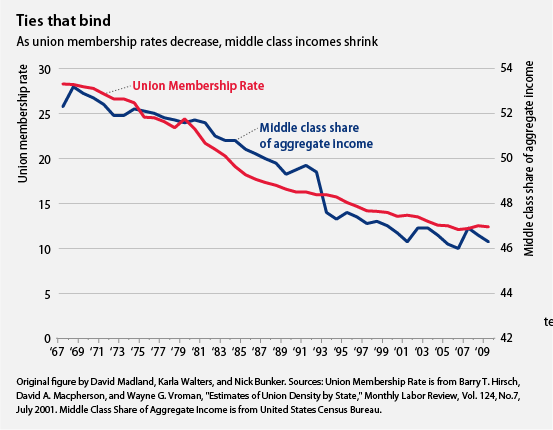
Ever since the 60s, real wages have remained mostly stagnant  – even taking a downward trend in the past year. Although maybe our nominal wages have increased, our real wages have remained the same and even more alarming the purchasing power of income has plummeted. Even worse so, the price of food and energy has gone up in recent years and we’re still working the same amount of hours, sometimes more. Where is the improvement and, most importantly, why is the middle class shrinking? Although all this issues would usually mean a rise in unionization amongst workers and rallies to demand for higher wages/benefits and perhaps more equal distribution of wealth, as happened during the Great Depression and the 1910s, union membership has actually paradoxically decreased in the last 50 years.The Bureau of Labor Statistics reports that only 6.9% of workers in the private sector are union members.

Although I’ve oftentimes heard the right demonize unions as dangerous to the delicate fabric of a free market, and oftentimes advocate enacting legislation to curb their power, there is no question the decrease in union membership has had a direct effect on the concentration of wealth in the United States and the middle class share of aggregate income. Here is are the results that were found by Karla Waters and David Madland of the at the Center for American Progress (CAP):
Now, before I get to the credit illusion, which is likely the culprit, first we have to dispel a few arguments against the stagnation of real wages in the United States – three of them specifically I want to talk about.
Q: Well, maybe workers’ productivity has not increased and their real wages are a direct result of a stagnation in their output? This cannot be true, hourly outputs per workers have actually been steadily increasingThis is based on information from the Bureau of Labor Statistics and Bureau of Economic Analysis; there is indeed a growing gap between output and real wages:
Q: The average income per household has gone up, isn’t that inconsistent in the stagnation of real wages? 
No, it is not. The Second Wave of feminism, which started in the early 60s, brought many more women to the workforce. It’s not that the workers are bringing more real income home, it’s that more people are working in the household. In an article in the journal article by Rebecca A. Clay of the American Psychological Association:

In 1940, according to the Employment Policy Foundation’s Center for Work and Family Balance, 66 percent of working households consisted of single-earner married couples. By 2000, that percentage had dropped to less than 25 percent. By 2030, the center estimates, a mere 17 percent of households will conform to the traditional “Ozzie and Harriet” model.

It is this phenomenon that has caused an increase in average income per household – there are now many more new sources income per family, but that doesn’t necessarily tell us anything about the average real wage for each individual bringing it home.

Q: You are not adding benefits to the real wage. The Bureau of Labor statistics has shown there has been a upward trend in real compensation per hour since the 1940s. Does this not explain the stagnation of wages?

It is true there has been a steady increase of real compensation (wages + benefits) per hour, below is a graph taken from the Bureau of Labor Statistics;

However, we have to look at this data with the increase in workers’ output rather than by itself. Since the year 2000, there has been especially a disconnect between real compensation per hour and output.
But this disconnect in average hourly compensation and productivity started far before the 00s; it actually began in the late 70s and got progressively worse since the Reagan years. Below is a graph from the Economic Policy Institute;
And although this graph does not show the growing gap between productivity and average hourly compensation since ’07, it has gotten much worse since then. So yes, average hourly compensation has been increasing but not as nearly as the same rate as productivity has.
————————————————————————————————————————————-
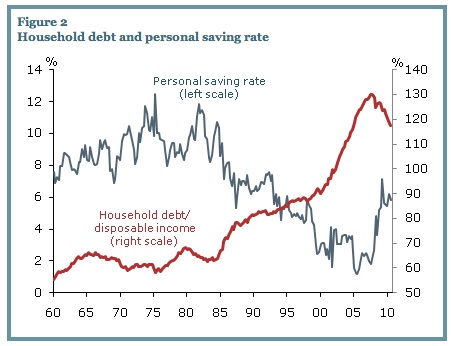
Now, for the topic of this post which may actually be shorter than the background information; Why aren’t the workers mobilizing and demanding higher wages as they did in the first half of the 20th century? There are many reasons; one being the destruction of unionism during the Reagan years and another being the of spending money you don’t actually have; the illusion of credit. Ever since real wages have become stagnant and the sharp decline of unionization in the 80s, there has been a sharp increase in household debt in the United States, which actually dissuades workers from demanding higher wages in some respects. It is this exploitative dichotomy that has kept corporate profits high and wages low; all in the guise of “buy now, pay later!” and ‘economic growth.
Below is a graph of household debt versus persona savings taken from ‘The Basis Point,’ a blog by mortgage banker Julian Hebron:
Why is the middle class shrinking and being anesthetized by credit? It is this type of behavior that drives society outside of its means and gives it working class families the false perception that their wages are increases; maybe nominally they are, which is deceptive in itself, but the main hurdle we must overcome is realizing the distraction of mass consumption by credit going forward. This requires questioning this entire system which has, for the most part, become based on credit and money yet to be paid. I highly fear the collapse of this ‘credit culture’ and the shaky foundation it is built on; And perhaps worst of all, we are unjustly condemning future posterity to debt bondage. What happened during the crisis of 2008 we may find to become a staple in the modern 21st century economic model; and since debt wasn’t properly liquidated, worse may be yet to come. The functionality of such an illusionary market method I am highly skeptical of, and its outcome will most definitely hurt the current mainstream liberal capitalist model.
YesterYear Once More

Life as it was reported back then

Victor Serge's Ghost

"One must range oneself actively against everything that diminishes man, and involve oneself in all struggles which tend to liberate and enlarge him"

Collecting Russian Art

20th century Russian art and its uniqueness

Communist League Tampa

proletarians of the world, unite!

Mosul Eye

To Put Mosul on the Global Map

Uglytruth-Thailand

Thai politics

Yanis Varoufakis

THOUGHTS FOR THE POST-2008 WORLD

Fractal Ontology

refracting theory: politics, cybernetics, philosophy

The Disorder Of Things

For the Relentless Criticism of All Existing Conditions Since 2010

Valentino's blog

A blog about visual arts (well, mostly...)

Negative Catallactics

institutional political economy, social ontology, neopragmatism, critical theory

rheomode

a research practice working at the intersection of architecture, technology, art and ecological pedagogy

Paths to Utopia

scattered reflections on politics for our time

Evvycology

It's Evelyn, It's Ecology, all in one convenient package

Idiot Joy Showland

This is why I hate intellectuals

All that is Solid for Glenn Rikowski

All that is Solid ... is a radical blog that seeks to promote a future beyond capital's social universe. "All that is solid melts into air" (Karl Marx and Friedrich Engels, 'The Communist Manifesto', 1848).

Symptomatic Commentary

Notes, Interviews, and Commentary on Art, Education, Poetics, and Culture

The View East

Central and Eastern Europe, Past and Present.

Uneven And Combined Development

theorising the international

Bezbozhnik - безбожник

On anti-religious propaganda in the early USSR, with some disgressions on the Russian Soul.

Nationalism Studies

Monitoring the Changing World

Old Woman on a Bicycle

My Photography, Mostly

Sráid Marx

An Irish Marxist Blog

Pedagogy & the Inhumanities

Pedagogic nihilism fights a windmill battle against international capital

Peter Marcuse's Blog

Critical planning and other thoughts

communists in situ

leberwurst proletariat

People and Nature

Some socialist ideas about society, the earth and their interaction

Posthegemony

Something always escapes!

New Historical Express

(Formerly Hatful of History)

RedneckRevolt Blog

Dave Strano | Anti-fascist | Anti-racist | Gunslinger

Words As Intervention

Anthropological Reflections

"And you shall teach this to your children"

A Jewish family's journey through Palestine

BINARYTHIS

EVERYTHING YOU ALWAYS WANTED TO KNOW ABOUT GENDER BUT WERE TOO AFRAID TO ASK

The Renaissance Mathematicus

Just another WordPress.com weblog

GraecoMuse

ἓν οἶδα ὅτι οὐδὲν οἶδα