616px-William_Blake_-_Socrates,_a_Visionary_Head_-_Google_Art_Project

Socrates, a Visionary Head (1820) by William Blake

In Athenian society during Greek Antiquity, religion played a crucial role in mediating public and state affairs. It served a social function rather than a personal one. Polytheism was embedded as the cultural foundation of Athens, where “priests and officials were regularly voted honors for their sacrifices that they had performed ‘on behalf of the Athenians’ or ‘for the health and safety of the Athenians’” (Parker, 95). Assemblies were opened with religious rituals to demonstrate good faith (Parker, 100). Thus, although individualist in nature, Athens was paradoxically mostly collectivist in its interpretation of religious affairs. To go against this consensus was public suicide – and likewise, any denigration of these practices was met with scorn by Athenians, especially by the more conservative members of the ruling class. For Socrates, this would mean his eventual trial and execution.

Impiety is relative to the culture in question. When discussing the charges against Socrates, it is important to realize the society which produced them. Firstly, the assumption must be made that Athenian law was justified in prosecuting persons for impiety, despite the fact that this type of offense does not exist in the contemporary Western world. From there, having abandoned our modern biases, the real contextual controversy arises – was Socrates impious or not?

Given what is known about Athenian religion, it would be very probable to argue Socrates was in fact guilty. In Plato’s account of the trial, Socrates speaks of a divine voice that prevents him from doing certain actions.

It may seem strange that while I go around and give this advice privately and interfere in private affairs, I do not venture to go to the assembly and there advise the city. You have heard me give the reason… I have a divine or spiritual sign… This began when I was a child. It is a voice, and whenever it speaks it turns me away from something I am about to do, but never encourages me to do anything (Apology, 31c – 31d)

Death of Socrates (1787) by Jacques-Louis David

Death of Socrates (1787) by Jacques-Louis David

In alternate translations, this “divine or spiritual sign” is called daimonion in Greek. According to Socrates, this voice has been present since he was a child. He follows it to a fanatical degree, resembling religiosity, and it “continues [to come] to [him]” (Euthyphro, 3b). To the typical Athenian observer, Socrates’s daimonion comes off as antithetical to religious norms. He had a private channel of talking to the gods (Ferguson, 174), which threatened the power of priests who were seen as the mediators between gods and man. Plato hints towards the rowdiness of the crowd as Socrates truthfully explains his “inner voice,” while at the same time begging the crowd to bear with his defense and believe him (Apology, 31a).

In the earlier part of Apology, Socrates tells the story of Chaerephon and the oracle which proclaimed that there is no man wiser than Socrates (Apology, 21a). Socrates goes on to question different groups of people, each skilled in their craft, to test if their wisdom was greater than his own. “As a result of this investigation… I have acquired much unpopularity,” Socrates goes on to remark (Apology, 23a). In an effort to justify his inquiring, he appeals to the gods.

So even now I continue this investigation as the god bade me – and I go around seeking anyone, citizen or stranger, whom I think wise. Then if I do not know who he is, I come to the assistance of god and show him that he is not wise. Because of this occupation, I do not have the leisure to engage in public affairs to any extent, nor indeed to look after my own, but I live in great poverty because of my service to the gods (Apology, 23b).

However, the immediate question that arises is – when did the gods ask that of Socrates? There was no command by the gods for Socrates to do such actions. The oracle merely declared that he was the wisest of men. The story is, therefore, inconsistent. It is likely that Socrates said this to appeal to the audience and to further prove his piety, albeit disingenuously.

Socrates’s assertion that his actions were god-inspired can be interpreted differently when related to his daimonion. He describes his divine signs as never action-inducing, but are rather a means to prevent him from doing wrong. Xenophon’s account of the trial disputes this. Socrates says bluntly, “a clear divine voice indicates to me what I must do” (Xenophon, 12). This is a noteworthy distinction. According to Plato, Socrates’s spiritual visions prevent him from doing certain actions. In Xenophon’s account, these induce him to act. Therefore, Socrates’s appeal to piety is a method to mask this inner voice. Regardless of this voice’s origin, be it religiously rooted or not, such a phenomenon goes against the orthodox Athenian conception of religion. Athenians practiced a public religion, not one of unique personal revelation – if such an interpretation was to take hold, the chief structure of Athenian culture would lose its rigidity. This was the fear of the Athenian ruling class and why Socrates was deemed impious, despite his efforts to mask these “voices” through the gods. In the context of the city’s religion, it certainly went against the consensus.

There are hints of Socrates’s skepticism in Plato’s Euthyphro. In the beginning of the dialogue, he questions the basis of believing in the stories of the Homeric gods (Euthyphro, 6b). However, this by itself is not entirely impious. Dr. Manuela Giordano-Zecharya writes in As Socrates Shows, the Athenians Did Not Believe Not in Gods, “[Athens] was moving away from a focus on ‘belief’ and towards questions of ritual, power relations and symbolic ambiguity…” (Zecharya, 328). Therefore, the fact that Socrates was questioning the Homeric stories themselves was not impious – it was that he responded to his skepticism by failing to engage in religious public life as he truthfully tells the audience in Apology.

Given what is known about Athenian religion, Socrates was indeed impious. His impiety can be broken up in two parts. One, Socrates failed to engage in the public rituals which held Athens together. Religion served a social function, to maintain hierarchy and social cohesion, and his absence from these customs was seen as contrary to orthodox traditions. And second, Socrates’s daimonion angered the ruling religious class in Athens since it was unprecedented. It created a personal channel with which Socrates could speak to the gods. And if such a conception became commonplace, it would leave religion to individual speculation and action rather than to experts. Aside from being offensive to the religious ministers, it threatened the Athenian consensus on religion. Simply put – regardless if death was the proper punishment or not – Socrates was impious.

***

– Parker, Robert. Polytheism and Society at Athens. USA: Oxford University Press, 2007. Print.

– Cooper, M. John. Five Dialogues. Hackett Pub Co, 2nd Edition, 2007. Print.

– Freguson, A.S. The Impiety of Socrates. The Classical Quarterly, Vol. 7, No. 3 (Jul 1913), pp. 157-175

– Giordano-Zecharya, Manuela. As Socrates Shows, the Athenians Did Not Believe in Gods. Numen, Vol. 52, Fasc. 3 (2005), pp. 325-355.

I. Jean-Paul Sartre’s Maxim

sartre-endIn October of 1945, Jean-Paul Sartre gave a speech at the Club Maintenant. His remarks would become the basis of his next book, Existentialism and Humanism, published in 1946. In it, he establishes the idea of “existence precedes essence,” which would become the maxim of successive existentialist thought. This statement was a reversion of previous Christian arguments on existence, which argued God crafted an essence before one’s actual birth through a divine plan. Sartre recanted this idea and instead inverted it – rather than preceding existence, each individual is responsible for subjectively crafting one’s own essence, where he defines himself to his own liking. Thus, true “freedom” is the ability to authentically craft our own individual essence.

Sartre makes these claims of “defining our own essence” within a capitalist framework. In retrospect, our “essence” cannot be autonomously defined in an environment which manipulates desire. In other words, in order for our desires to be authentic, our environment must, too, be authentic. Capitalism maintains its hegemony through a production of desires which manifests itself through our consumption. Therefore, since consumers – which is all we are reduced to, consumers – exist in an artifice, their essence is also artificial. Sartre’s maxim would be unequivocally true if a coercive environment did not precede our existence. However, the truth in his statement is only partial. Rendered inauthentic by mass consumerist society, we are left with merely just existence without essence. As Oscar Wilde put it half a century beforehand, “To live is the rarest thing in the world. Most people exist, that is all” [1].

II. Marx’s Conception of Alienation 

Philosopher Karl Marx in the 19th century described a phenomenon known as proletarianization. It is a form of downward mobility, where the working class grows larger through increasing levels of capital accumulation. As a result, wealth becomes transferred to fewer and fewer hands as the individuals who were once employers now are demoted to mere workers with labor power. And with this transformation, more individuals are coerced into selling their work for a wage. It through proletarianization that an increasing number of individuals experience “subjectivity without essence” – in Marxist terms, alienation.

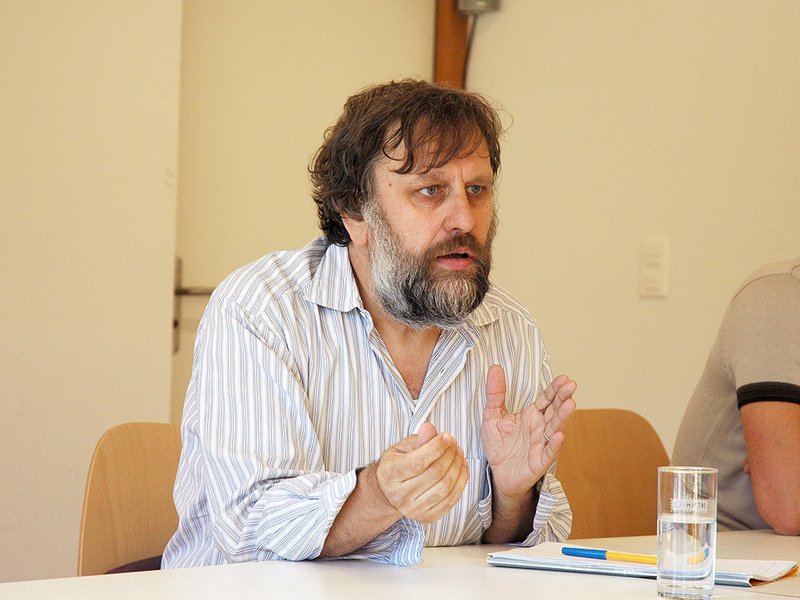
responseIn modern late capitalist society, this idea has been pushed to its very extreme. Contemporary thinker Slavoj Zizek argues that the current historical situation should push us to radicalize the idea of proletarianization further, since its use has expanded far beyond the confines of the industrial setting [2]. Proletarianization is much more than a reference to a growing working class; it is a condition where an individual is ripped of his/her product, that which is naturally theirs. Therefore, Zizek argues, capitalism embraces this as an end far beyond the base of production. The current ecological crisis is yet another attempt to separate us from our environment. Similarly, intellectual property is a way to separate us from collective ownership, ripping us apart from our substance. In an effort to compartmentalize every aspect of life, capitalism detaches man from his surroundings and creates separation where there was previously none [3].

Thus, given these efforts to fundamentally alter human relations, can Sartre’s conception of essence truly exist in any authentic sense? If essence demands subjectivity than we cannot call anything contemporary “authentic” since our subjectivity is constantly being created for us rather than by us. As Zizek calls it, capitalism leaves us “subjectivity without substance,” in that it leaves us with constant displacement beyond our personal control.

III. Existing within the Simulacra

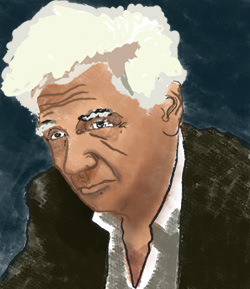
Artistic depiction of philosopher Jean Baudrillard.

Artistic depiction of philosopher Jean Baudrillard.

Now, how does freedom fit into this end? It simply cannot. True freedom cannot coexist with institutions which subjugate, separate, and alienate individuals. Philosopher Jean Baudrillard in his treatise Simulacra and Simulation denounces contemporary society as merely an artifice masquerading as the Real by eliminating any alternatives to its hegemony. He writes, “The simulacrum is never that which conceals the truth—it is the truth which conceals that there is none. The simulacrum is true” [4]. Therefore, contemporary capitalist society – the simulacrum – attempts to normalize exploitative relations in an effort to make them appear universal. Because of this, we oftentimes assume liberal conceptions of liberty are the only form of liberty. In retrospect, this is the only form of liberty that can exist within a capitalist framework. Since systemic forms of oppression are cyclical in capitalist systems, they become normalized and expected. Therefore, commonplace conceptions of “freedom” are skewed and limited to the current economic paradigm and fail to transcend it.

Because liberal freedom is mainstay, proletarianization is seen as complementary to liberty in contemporary Western society. It is not seen as a menace; rather, it simply is. It is this acceptance and rationalization of oppression which prevents freedom from expanding. Worse so, it makes individuals hesitant to even accept greater conceptions of freedom. Again, it all relates back to Baudrillard’s conception of the artifice – the simulation becomes the only reality, while the Real is nonexistent. And it is within this artificial framework that radical freedom, free of institutional oppression and real autonomy, cannot exist.

Jean Baudrillard’s Simulacra and Simulation derives much of its theories on artifice from the French Situationist school of thought, particularly Guy Debord. He writes in Society of the Spectacle, “… just as early industrial capitalism moved the focus of existence from being to having, post-industrial culture has moved that focus from having to appearing” [5]. Similarly, Baudrillard speaks of the artifice as symbols; these symbols reaffirm themselves and the existing artifice they create. Most importantly, such an environment induces individuals to uphold the artifice as if it were the Real. As Debord argues, “The more powerful the class, the more it claims it does not exist.” Because the Real can never be acknowledged, subtle censorship is crucial to maintaining its hegemony; and it is within this paradigm that freedom cannot exist in any complete context.

While we continue to exist in the artifice, individuals cannot achieve their essence. Hence, Sartre’s maxim is incomplete. Since human agents are victim to their circumstances, hierarchies of oppression hamper any realization of true freedom. These systemic imbalances in in class, race, sex, and gender maintain themselves by merely being viewed within liberal capitalism, rather than through the Real. Freedom is unable to be fully realized with this intact. In order for real freedom to be actualized, man has to transcend efforts of marginalization in order to complete the second half of Sartre’s phrase – and it begins by dismantling the institutions that constrict individual autonomy and liberty.

***

– Estranged Labor by a young Karl Marx discusses alienation as a concept. It is part of a greater collection called Economic Manuscripts of 1844. 

The University of Chicago’s prompts for the application process are always strange. This was one was simply “Where’s Waldo?” so I figured I would do an absurd, intentionally wordy, metaphysical take on it. This was written last year. 

                                                     ***

Identity is fleeting. The mechanisms of the human consciousness are constantly deliberating over choices, floating from each happening to the next successive amusement. Present in one, we feel feeble until we stride to the next great occasion, all while feeling uneasy in the immediate transition between them. In a constant shift from our environment, we find ourselves perpetually in action. Fluctuating between diverse surroundings is a characteristic of the human experience – it adds novelty to the mundane, and it brings spontaneity to an otherwise boorish routine. In an effort to escape our own disparaging alienation, we find ourselves in unceasing continuous motion.

Correspondingly, Waldo of the “Where’s Waldo” book series is the epitome of such a character. Thereby, the absurdity in finding Waldo, and pinning him to his immediate setting, would be to negate his very purpose. The essence of Waldo is perhaps, at its core, a poetic interpretation of modernity, of alienation, and of movement. Likewise, we cannot truly find Waldo; we must take it that he simply is. The absence of his existence, or the difficulty in finding him, is precisely how we discover him. It is by this token we must accept that Waldo’s very existence depends on his absence from it. Permanently in ephemeral bursts of motion, Waldo embodies the spirit of escape. Ultimately finding him, and fixing him to his surroundings, would do his significance a grave injustice.

Waldo’s continuous displacement is one of mystery, one which very much runs parallel to our own. Ironically, however, we must delineate the true nature of Waldo’s movements if we wish to pinpoint the true significance of his location, or lack thereof. Because Waldo is not present in our ordinary perception upon viewing a setting, he is ultimately absent from our recollection of it. Thus, in each environment, Waldo becomes a character that is conceived solely on his nonexistence. Upon looking for Waldo, we make the delicate assumption that he is unseeingly there while he may very well not be. It is this contradiction that brings us to an enigmatic conclusion; If Waldo is nowhere he is, by logical deduction, also everywhere. Simply put, by making the very assumption that Waldo may be in every setting we come across; we imply he also may not be. Such is the fine line we must walk. As it is said — if you love everyone, you truly love no one. If Waldo is seemingly everywhere, he is also nowhere. Lacking an anchor to any one environment, he is eternally in motion and consequently ubiquitous.

Waldo’s incessant movements to new settings share a few common threads with our universal experiences. We previously concluded that Waldo is constantly in motion and therefore everywhere. When juxtaposed against our desire to move, Waldo’s fleeting experiences are similar to our own except taken to the utmost extreme. Although we do not shift as quickly as Waldo, we sympathize with such an idealist desire. Thrown into a world of alienating modernity coupled with the lingering dissociating elements of mass society, we oftentimes have the longing for spontaneity to escape the fixed present. It is this emotion Waldo capitalizes on perfectly – in the enigma of his ever-changing existence, we find condolence.

In the struggle to find our utmost identity, we naturally feel inclined to transform ourselves upon meeting a new environment. Riddled with boredom and monotonous routine, we find ourselves constantly planning, and patiently waiting, for the next blissful happening. Waldo romantically captures this human phenomenon in full. Waldo’s quick departure from place to place, and the mysterious aura of his ventures, both speak volumes of the escapist tendencies we all personally undergo. Our desire for novelties is captured by Waldo’s hasty maneuvering to new settings, although we very well realize he may not even be present at all. The answer, then, to the age-old question of “where is Waldo?” is simple to articulate yet remarkably convoluted in its message; Waldo is everywhere and, at the same time, nowhere. Such is the absurdist paradox we must accept for the sake of consistency. Waldo cannot be detained to a single location; in all its irony, Waldo simply and merely is.

Jacques Derrida by Pablo Secca

Jacques Derrida

Mentioning Jacques Derrida makes some academic’s ears spike up. Derrida is known to be notoriously wordy, painfully dense, and riddled with jargon in anything he writes. Regardless of the difficulties, he manages to reveal patterns in Western thought that dominate discourse. One particular trend, however, forms the crux of his criticisms — the binary system.

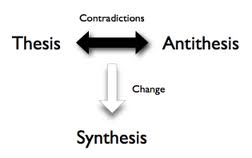
Throughout Western thought, arguments have been presented in dichotomies. Socrates framed his philosophy through discussion by conversing with another party which would argue the objecting point. With the work of philosopher Georg W. F. Hegel, we have given this a title. Dialectics, as it’s called, consists of a thesis and an antithesis with the hope of producing a synthesis. This triad has become the basis of our argumentative Western society.

Dialectics-12

However, the influence of the dialectic process goes much further than argumentation. The dichotomy has become so strong that we presumably view all ideology and ideas within a binary. These binaries can be either contradictory (dialectic) or supplementary to each other, but are always opposite in meaning. And one is always seen as more important than the other. Western binaries tend to be, as a rule, hierarchical and unequal. For Derrida, these relationships are important to understand to fully grasp theory or texts. It is equally important to undermine — or deconstruct — these relationships and maybe even, in some cases, try to break their authority to reach a grander conclusion.

Let’s take, for a moment, the actual binaries and their content.

B versus A

Whereas is superior to A.

Good  ¦ Bad

Mind  ¦ Body

Reality ¦ Appearance

Self ¦ Other

Speech ¦ Writing

Man ¦ Woman

White ¦ People of Color

Bourgeois ¦ Proletariat 

These binary distinctions are based on institutional conceptions. Taken a step further, we can examine their relationship. “A” is supplementary to the dominate “B.” Noted literary critic Barbara Johnson explains this relationship in an essay titled “Writing” from Critical Terms for Literary Study.

A is added to B.

A substitutes for B.

A is a superfluous addition to B.

A makes up for the absence of B.

A usurps the place of B.

A makes up for B’s deficiency.

A corrupts the purity of B.

A is necessary to that B can be restored.

A is an accident alienating B from itself.

A is that without which B would be lost.

A is that through which B is lost.

A is a danger to B.

A is a remedy to B.

A’s fallacious charm seduces one away from B.

A can never satisfy the desire for B.

A protects against direct encounter with B.

These observations are not absolute. Different Western binaries express different relationships with each other; these are not applicable to all, but each of the examples given can fit into a few of these criteria outlined.

We have established the fact that Western dichotomies can take on two forms: contradictory (dialectic) or supplementary. Generally, discussions tend to be dialectical while the binaries in individual ideologies tend to be supplementary. This trend in Western thought is crucial in understanding the nature of discourse and its development. Particularly in the United States, most political speak is phrased as two sides to an argument. The outcome of argumentation is generally one of the following three scenarios — no conclusion is made, one side is proved correct, or a fusion of both opinions. It would be a insult to call American politics dialectic in nature, since a synthesis is seldom reached, but the binary of opinion is still present. This creates the illusion of two options and the constant regurgitation of the “lesser of two evils” argument in every aspect of American politics. Of course, European politics is not two-party centered. However, the Western binary still applies. Seldom is the dialogue expanded beyond the back-and-forth format of mindless debate and bickering.

Perhaps it is time to expand the periphery. The endless “debate teams” on high school campuses, the lecturing model of education, is based on a two-person argument. Inherently competitive, it usually demands one party to be deemed victor in “beating” his opponent during a debate. In education, the victor is clear — the instructor is the power in charge of mediating opinion and presenting information. During formal debate, the victor is decided through vulgar verbal exercises. Whatever the case may be, dialogue has institutionally become synonymous with debate and heated competition which is a perversion of what it actually means.

2617765Dialogics is concept conceived by Russian philosopher Mikhail Bakhtin. It is seen as a methodology of dialogue that goes beyond dialectics. Rather than dialectics, where once ideology competes with another, dialogics is an alternative mode of discussion where many different ideas exist in the same space. There is no ideological closure afterwards and is aimed at progressing thought rather than resolving a contradiction. Bakhtin makes the argument that all thought is inherently dialogical. Nobody speaks in a vacuum — your language is based on what was said prior and the reaction it may create. Thereby, language is dynamic and perpetually redescribing the world. From this he concludes that dialogics has always existed as a phenomenon of speech.

What can we create from a model of dialogical discourse? We can create cooperative learning environments. We can destroy hierarchy relationships in public forums and education. However, dialogics is not a substitute for a dialectic process of dialogue. They have different uses. The issue is, however, that we have given debate precedence. Likewise, we have given these restricting binaries precedence. The aim of dialogue is not a cut-and-throat solution. It is for the facilitation of free thought and new ideas. It is a space where prejudice is suspended and where individually freely converse. And the need for such a discussion model becomes more and more apparent as we realize that a standardized education model of lecturing is not a satisfactory one.

Theatre of the Oppressed is a beautiful dialogical art where the audience becomes drama and enter the play themselves, rather than sitting as spectators.

Theatre of the Oppressed is a beautiful dialogical method where the audience becomes the drama and enters the play themselves, rather than sitting as spectators.

As expected, the college process of shopping, moving in, and getting comfortable eats up a lot of time. I haven’t been writing much lately and I feel useless for not doing so. Now that I’m finally settled, I feel as though I have more free time than I ever did. For those that care to know, this blog is not dead nor is it extending its inactivity. I expect to collect my thoughts on this medium from my studies and personal readings as I have before, but instead this time with more rigor and regularity.

I also hope to renovate the blog format a bit more, but that’s for a later date.

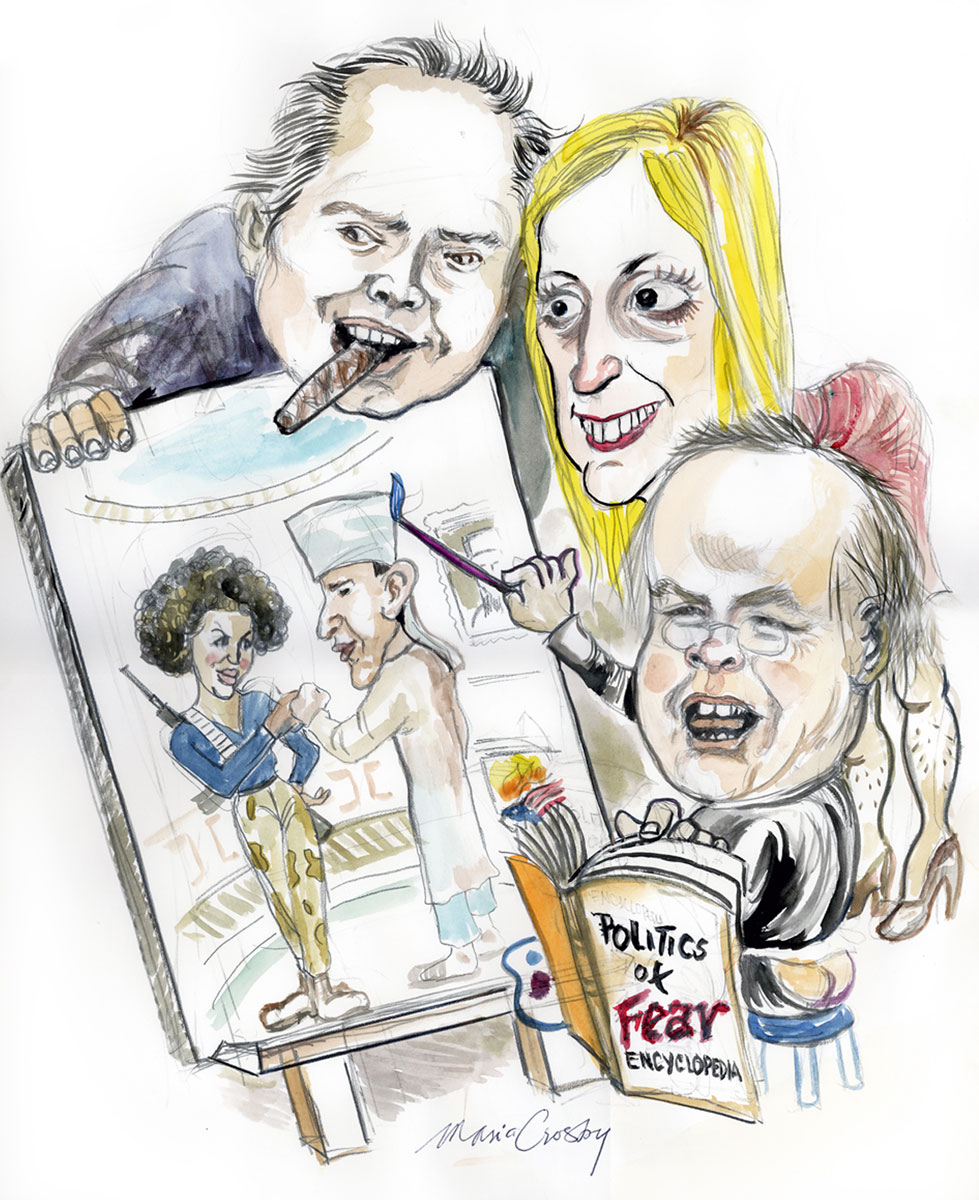
Fear is profitable. After all, what better way to oil the gears of the military-industrial complex and accumulate wealth than with a frightening slogan?  Better yet, have it be a frightening slogan that portrays those that disagree as weak and worthy of scorn. In Western society, it has become more and more prevalent, since the economic crisis of ’08, to portray minorities as scapegoats.

Generally speaking, the historical precedent is one that sadly works similarly every time. During recessionary periods, fingers are pointed. Groups are targeted. And it happens because it is convenient. It is easy. It is easy to characterize the “Other” in society as vile for political gains, since they lack the social power to fight back. As the majority in the society scramble to reclaim all they have lost economically, they begin to find solace in blaming others rather than the system that produced it. This same phenomenon has reproduced itself not only the United States, but in virtually every Western society since the Great Recession of 2008.

In Europe, the crises of debt and unemployment has allowed for a frightening increase in nationalism. Nostalgia for fascism in Greece finds its face in the Golden Dawn party. Xenophobia voices are vulgarly heard through France’s third largest party, National Front, and through Germany’s National Democratic Party. In Hungary, the Jobbik party has risen to become the third largest party through Hungarian irredentism and anti-Semitism. Even in the United States, minorities are denigrated as being “moochers” as the right insists on tighter immigration regulations and cuts to social safety nets. If the economy is of greatest importance, then why do we keep allowing racist “culture wars” to dominate politics? At the most critical point, when people have everything to lose and nothing to gain, the individuals with actual solutions begin to scramble and watch as people repeatedly choose nationalist strongmen over economic sustenance.

The problem lies in ideology. Westerners are very coddled and institutionalized in a way that makes them coalesce to authoritarian power. A right-wing deviation from the normal political speak is not all that much of a radical bent compared to left-wing calls for economic fairness and institutional overhauls. For one, Western people take pride in their judicial system and police force, claiming it to be symbolic of genuine integrity. In the United States, the military is always superimposed with patriotism and honor — and going against the grain is seen as foolishly “un-American.” The institutions that uphold these spheres of power craft in the population a feeling of trust. This trust is easily mended and oftentimes exploited. And all of this is strengthened and solidified through rhetoric. Contradictory slogans equating militarism with freedom is commonplace, at least in American politics. Naturally, this is used as political bait; if you attack the militarization of the world through American power, you must despise democracy and liberty despite it being anything but. The cognitive dissonance is so blatant, but yet it goes uncontested in the American mind and it serves to fester right-wing politics. Western politics has a predisposition to be right-wing politics.

Firstly, let me tell you what it does not mean.

It doesn’t signify a position that is at odds with a peaceful globalized world. It is not a luddite position against the stroke of history that is moving more and more towards interconnected communities through technology, innovation, and jurisprudence. If anything, this development is welcomed as a means of social advancement. We, anti-globalization advocates, aim at establishing transparent international bodies of people with institutions that breathe human rights, diversity, and democratic principles.

The real reason for concern is that modern markets are serving as an obstacle to such ends. The neoliberal doctrine of the past three decades has preached unity through deception. Now, spheres of influence have emerged that hark back to classical colonial relationships; the First World provides the capital, while the rest must labor. This leaves the Third World in a constant state of dependency. The mantra of benevolent “Westernization” is used as rallying call for economic expansion as age-old cultures are dismantled and replaced with chaos and violence. Plagued with the vestiges of colonialism, artificial lines have been economically reinforced in the Middle East, Africa, and elsewhere that have worked to heighten tensions. Blood oftentimes spills into the streets as sectarian violence pervades all aspects of post-colonial life while we live in luxury.

An iron boot has been placed on the necks of peoples outside the Western World — and the response from Western circles has been “this is for your own benefit.” Mainstream economists, along the likes of Paul Krugman and others, cite the “measurable improvement” despite these horrible conditions as a justification of economic slavery.

We argue this is wrong.

Therefore, anti-globalization is a position that seeks to break this illusion and expose the horror that is within, rather than give market expansion a justification that is both morally reprehensible and dismissive of the torturous plight incurred on Third World laborers. We, anti-globalization advocates, are not opposed to a global community of interconnected ideas and common interest — we accept this with open arms. However, an unsustainable world community of hierarchy and coercion is something that cannot be tolerated through any means.

Anxiety is the unpleasant feeling of an unrealistic fear. It is a human response to the absurdity of life’s displeasure and its seemingly aimless journey. Such feelings are largely created before choices of consequence, when an individual feels powerless, and where such an action could lead to possible pain.

One of the few actual sketches of Søren Kierkegaard.

The classic example is one philosopher Søren Kierkegaard mentions in his writing, The Concept of Anxiety. Take it that a man is standing alongside a cliff. He looks down and sees the drop below him. He fears the he may fall, but at the same time, he is terrifyingly intrigued. He has an impulse to jump, but he also experiences fear because he knows it would mean his imminent death. Kierkegaard calls this the “dizziness of freedom” — we have the freedom of choice, to make even the deadliest of choices, and this induces existential anxiety and dread. For most people, the fear of the death strays us away from jumping. For those that psychotically lack it, they succumb to their impulses and jump. In the case of the Biblical story of Adam of Eve, anxiety is understood by Kierkegaard as a precursor to sin. God tells Eve not to eat the fruit or she would face death and pain. Through this restriction, Eve is given a choice whether or not to eat the forbidden fruit. The anxiety of the moral decision is captured by her interaction with the serpent which tempts her to eat it — like the cliff, she feels compelled to jump. Kierkegaard, through this story, comes to a conclusion on sin. Sin is always preceded by anxiety. And the first such instance in Genesis, according to old Christian theology, was precluded by anxiety.

Although I take literal interpretations of Biblical texts with a grain of salt, the religious language in Kierkegaard’s writing can be replaced with more secular lingo and still be considered valid. “God” is symbolic of objective morality and sin is the failure to live up to it. Whenever an immoral act is committed, and a grave choice is involved, there is existential anxiety that precedes it. Kierkegaard contends that this anxiety can be mediated through eternal values that transcend the choices we are placed into, since our decisions are subject to the twists and turns of everyday life. He argues we must establish meaning through objective concepts that we should abide by. To explain this, he illustrates an image of a sailor lost at sea.

How, then, shall we face the future? When the sailor is out on the ocean, when everything is changing all around him, when the waves are born and die, he does not stare down into the waves, because they are changing. He looks up at the stars. Why? Because they are faithful; they have the same location now that they had for our ancestors and will have for generations to come. By what means does he conquer the changeable? By the eternal. By the eternal, one can conquer the future, because the eternal is the ground of the future, and therefore through it the future can be fathomed. What, then, is the eternal power in a human being? It is faith. What is the expectancy of faith? Victory-or, as Scripture so earnestly and so movingly teaches us, that all things must serve for good those who love God. [Eighteen Upbuilding Discourse, 19]

The Signal of Distress by Winslow Homer

The Signal of Distress by Winslow Homer

I disagree with Kierkegaard’s final conclusion on faith, because I take it that moral objectivity can be reached without divine inspiration, but his thought process is valid. Through an “eternal” morality, one can guide oneself through all of life’s moral decisions. The closest such axiom that exists in secular thought would be the “Golden Rule” which is derived from empathy: one should not treat others in ways that one would not want to be treated. Moral conclusions should not be based on the arbitrary ebbing and flowing of subjective life. If that was the case, to the common observer, heinous acts of immorality would be considered “moral” in the time period they were committed. Because slavery was at one time considered “moral” by popular standards, did that make it truly ethical? No, because it breaks eternal moral codes that are always true. Regardless of the time period, these principles stand tall and serve as a guide with which to judge decisions made in the past and those yet to be made.

Anxiety, therefore, is a symptom of a lack of existential direction. It is induced when an individual is lost in the random spontaneity of the natural world. Likewise, such anxiety can be mitigated when the individual develops a proper objective view on life. However, there is a minor caveat — the conclusions that the secular explanation gives us through the Golden Rule is one that still lacks proper foresight. Surely, acts of self defense are morally permissible, but how does that fit within the context of the Golden Rule? We know the assailant is committing an immoral act according to this axiom, but the question of self-defense is left unanswered. Therefore, an objective moral code that is derived from secular understanding requires a more nuanced explanation that is all-encompassing. It requires expanding to cover all aspects of an ethical life. It also requires constantly being tweaked using the Golden Rule as an objective starting point. Although not complete, the Golden Rule is the closest estimation of a moral maxim that many of our own decisions can be based around.

Kierkegaard, on the other hand, turns this conclusion on its head and argues that faith brings one to an eternal understanding that would work to subdue the existential anxiety and dread we experience. A morality based on divine command, a list of necessary obligations, is the simplest solution to the problem of objective ethics — the question is, however, from which command on high does one follow and is it ever disputable? I would prefer an objective ethics that is able to be tinkered with until a seemingly perfect code is established. One that is always applicable but subject to minor changes based on enlightened understanding, rather than an absolutist position that is easily exploited by power. Regardless, Kierkegaard is correct in his assertion of the necessity of an all-encompassing life view. It is necessary so that, just like the sailor of the story, one does not get lost in the waves of everyday life itself, which is too oftentimes muddled with subjective preferences and fleeting emotions. And succumbing to such feelings would be a perversion of reason and a squandering of life’s many splendors.

It is so comforting to know we have the George Soros types to criticize free market capitalism for us.

Yet again, the “left-leaning” part of the establishment lifts their glasses of Chardonnay wine in honor of their great achievements. They have done it again and muttered it endlessly  — “I will fight against economic injustice!” as they scurry back to their elaborate luxurious homes. No, we cannot actually go near poverty, it’s far too dangerous. We’d much rather take on the fight in the comfort of our homey leather furniture.

American liberalism is riddled with indulgence.  The higher class is seemingly always in need of some cause or another. Every celebrity needs one. And it becomes a spectacle to gawk at and for the rest of us to adore, be it token environmentalism or anti-racist campaigns that fail to address systemic institutions that perpetuate the actual problem. There was a bit of beauty in the left movements of the early 20th century because they were crafted by the people who were actually in need. As the American political spectrum moved further to the right in recent decades, the figureheads of what is seen as “liberalism” took on affluent personas rather than genuine struggles. Leftist movements died and liberals took to representing the ideological leftovers and then falsely claimed they fell in that same tradition.

George Orwell wrote an excellent essay in 1944 titled Propaganda and Demotic SpeechIn it, he discusses the aristocratic drawl and language used by pompous socialists that claim to speak on behalf of social justice movements while alienating any working people with their demeanor. He writes:

When recently I protested in print against the Marxist dialect which makes use of phrases like ‘objectively counter-revolutionary left-deviationism’ or ‘drastic liquidation of petty-bourgeois elements,’ I received indignant letters from lifelong Socialists who told me that I was ‘insulting the language of the proletariat.’ [1] 

This captures the separation between affluent academics and the toil of actual political action. Orwell, himself, realized this contradiction. Orwell was born into what he called the “lower-upper-middle class.” He struggled to reconcile his family’s complacency with British imperialism and his ideological views. He attempted to humble himself to working class life by documenting it, living it, and adopting its language since he felt the inconsistency was too great. He felt immensely guilty and could not handle what he viewed as hypocrisy in socialist circles. He writes in chapter nine of The Road to the Wigan Pier: 

Question a person of this type, and you will often get the semi-
frivolous answer, “I don’t object to Socialism, but I do object to
Socialists.” Logically it is a poor argument, but it carries weight with
many people. As with the Christian religion, the worst advertisement for
Socialism is its adherents. [2]

And it comes as no surprise that working class peoples are voting right-wing parties into power in Europe and in the United States. The worst advertisement for socialism is its adherents.

To this you have got to add the ugly fact that most middle-class
Socialists, while theoretically pining for a class-less society, cling like
glue to their miserable fragments of social prestige. I remember my
sensations of horror on first attending an I.L.P. branch meeting in London.
(It might have been rather different in the North, where the bourgeoisie
are less thickly scattered.) Are these mingy little beasts, I thought, the
champions of the working class? For every person there, male and female,
bore the worst stigmata of sniffish middle-class superiority. If a real
working man, a miner dirty from the pit, for instance, had suddenly walked
into their midst, they would have been embarrassed, angry, and disgusted;
some, I should think, would have fled holding their noses. [2]

Sadly, I picture this same reaction from American liberals and European left-leaning establishment officials. There is a feeling of dissociation when you attempt to create a movement while basking in comfort when you arrive home. The crucial difference is that the working poor do not enjoy that same benefit of security when they arrive home — being involved is more costly for them than it is to you. Every hour lost for activism is an hour that they could have earned for their sustenance. They don’t have time for ideological gimmicks and costly activist projects — rather, they are attracted to movements that give them stability and economic power where they lack it. With students being the bastion of leftist power since the 1960s, the emphasis on working class strength has been largely dismissed. Now, it sometimes borders on self-satisfaction more than anything else, as we distance ourselves from the demographic we are attempting to fight for. And, at the same time, the rift between the working poor and the higher castes of society grows as the rhetoric becomes more and more obscure. Let us be honest, there is no surprise that the lower classes are voting for reactionary parties in large numbers. We caused it.

The problem with socialism is not its ideology, but its adherents. There is a certain image of the “leftist” that is painted in the Western mind which has a stigma. It is not seen as a broad movement of many different faces that appeal to the general public — much of it has descended to petty ideological battles on the internet and just general disorganization and sectarian confusion. Let us drop the wordy rhetoric and call out inconsistency when we see it. And it begins with denouncing the hypocrisy of those in power that have falsely claimed the title of being someone “on the left.” To leave them without criticism would paint us all with the same brush — we would all be forced to bear the brunt of their hypocrisy. And frankly, we are now and it is hurting us.

*** 

So What’s the Problem with Champagne Socialism? 

Why Working-Class People Vote Conservative 

– The final Image of the “Popular Front” in 1936 was taken from a Tablet Article titled Occupy Paris.

Note: This was written before the election of Nicolás Maduro. 


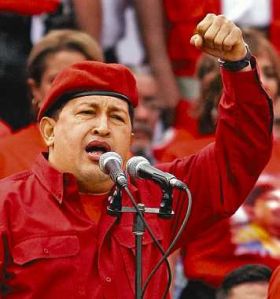
The election of 1998 was one of righteous importance to Venezuelans. Within the shadow International Monetary Fund and under its watchful eye, Venezuela had seen ten of its banks [1] collapse in the years prior, its Bolivar currency degenerate [2], and inflation run rampant [3]. Violent outbreaks plagued the city bounds and immediate countryside, sparked by Hugo Chavez’s failed coup attempt of 1992. During the 90s presidency of Rafael Caldera, the socioeconomic inequality of Venezuela reached its frustration and ultimate climax. Tipping over, it found its ultimate solution, by popular vote, through Hugo Chavez’s victory in December of 1998 – and with it, puntofijismo, the three-party system that held Venezuela by the handles since 1958, fell to Chavez’s Bolivarian Revolution.

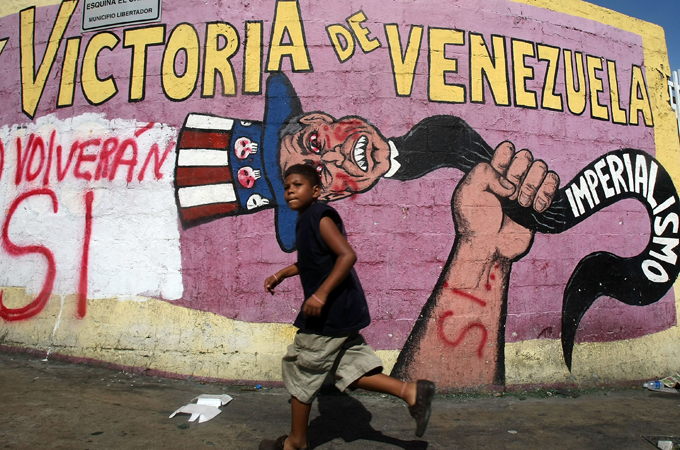
Anti-imperialism and hostility towards Western influence has been commonplace since the Bolivarian Revolution.

Anti-imperialism and hostility towards Western influence has been commonplace since the Bolivarian Revolution.

In many ways, the importance of Hugo Chavez’s first election victory extends beyond his left-leaning economic policies.  It represented a significant shift in Venezuelan politics, and the rest of Latin America, against the Washington Consensus that was taking capital away from Venezuelan hands for decades. More broadly, it captured a struggle within a more pressing grander narrative that included centuries of Western economic infiltration and exploitation since the colonial era. The emergence of leftist movements in Latin America after Chavez’s rise to power, called the ”pink tide,” symbolized a crucial break from what was once the normality of Latin American economic dependence. This critical change owes its thanks to the richness of Venezuelan resources, particularly oil. The oil card that Venezuela possesses is a keen one in international politics and it enabled Chavez to raise Venezuela from its former subservient position in comparison to Western economies. Currently, oil stands as the stronghold of economic power among modern nations and it grants Venezuela a necessary springboard with which it can bring its country, and the rest of Latin America, to prominence.

Chavismo leaves much to be desired.

However, in all its oil wealth, this treasure has created a dubious contradiction in the institutions that control Venezuela. Chavez’s legacy will surely leave some form of his political ideology, chavismo, as the engine of Venezuelan politics, but also remaining will be the programs and structures that he helped expand through nationalized oil revenues. Many of these are not transparent. The uncertain nature of the Venezuelan future resembles a double-sided sword. On the one hand, public ownership of the oil industry has allowed for Chavez’s reformist positions for social justice to take root. Venezuela’s poverty rate, unemployment rate, and infant mortality rate have all decreased significantly [4] and the country now boasts the lowest level of income inequality in Latin America [5]. On the other hand, despite these gains, homicide rates have increased multifold [6] and institutional corruption has remained frighteningly high regardless of Chavez’s party platform of “anti-corruption” [7]. A mixed bag of success, Hugo Chavez has managed to pursue some forms of social justice and alternate institutions – such as the radical democratic experiments of communal councils (consejos comunales) – while still working alongside the dishonest power structures that existed before the Bolivarian revolution. It is this dangerous relationship that might reverse the moderate gains made for the working poor in Venezuela, now that Chavez has passed away. Such corruption has the ability to spiral into the backdoor privatization and foreign meddling that was seen in the crisis prior to 1998.

It is this uncertainty that calls into question the longevity of Chavez’s policies and chavismo. The prediction of what will become of Venezuela’s leftist movements is a difficult one.  There are relatively two major paths that could very well be taken, one clearly more preferable than the other. Venezuela could continue to pursue its expansionary social programs, using the power of oil politics, while in the meantime working to stamp out the fraudulent institutions that have been a staple in the Venezuelan experience since colonial times. Contrarily, it could also succumb to Western finance and right-wing movements that caused the economic collapse of the 1990s, impoverishing the majority while enriching the coffers of the higher castes of Venezuela. During his presidency, Hugo Chavez managed to take some crooked middle route by granting the state economy some room to pursue its corrupt practices while also responding to popular support through governmental programs and the socialization of private profits. However, this route is unsustainable. Unless the fraudulent and cyclical problems of Venezuela are addressed, its institutions will continue to hollow until its message of social justice becomes all but meaningless.

Thus, the burden lies on the working people of Venezuela to actively support and accept, as a basic right, the human necessities that were only recently granted to them. The ideology of chavismo should not be a temporary one, given it brought popular democracy to a largely undemocratic system, but it requires persistent vigilance against the reactionary powers that seek to destroy it and return Venezuela back to economic madness. Thereby, it is in the hands of the Venezuelans themselves to remain passionate enough to prevent a reversion to pre-Chavez policies. However, as to if they will actually do so with enough potency, that is really anybody’s guess.

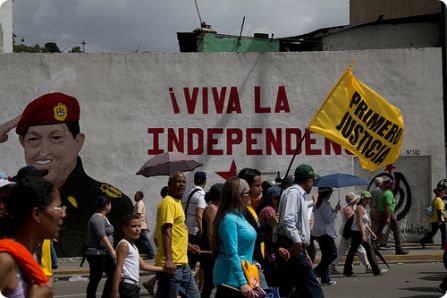
Chavez-inspired murals are scattered about in Venezuelan cities.

Chavez-inspired murals are scattered about in Venezuelan cities.

YesterYear Once More

Life as it was reported back then

Victor Serge's Ghost

"One must range oneself actively against everything that diminishes man, and involve oneself in all struggles which tend to liberate and enlarge him"

Collecting Russian Art

20th century Russian art and its uniqueness

Communist League Tampa

proletarians of the world, unite!

Mosul Eye

To Put Mosul on the Global Map

Uglytruth-Thailand

Thai politics

Yanis Varoufakis

THOUGHTS FOR THE POST-2008 WORLD

Fractal Ontology

refracting theory: politics, cybernetics, philosophy

The Disorder Of Things

For the Relentless Criticism of All Existing Conditions Since 2010

Valentino's blog

A blog about visual arts (well, mostly...)

Negative Catallactics

institutional political economy, social ontology, neopragmatism, critical theory

rheomode

a research practice working at the intersection of architecture, technology, art and ecological pedagogy

Paths to Utopia

scattered reflections on politics for our time

Evvycology

It's Evelyn, It's Ecology, all in one convenient package

Idiot Joy Showland

This is why I hate intellectuals

All that is Solid for Glenn Rikowski

All that is Solid ... is a radical blog that seeks to promote a future beyond capital's social universe. "All that is solid melts into air" (Karl Marx and Friedrich Engels, 'The Communist Manifesto', 1848).

Symptomatic Commentary

Notes, Interviews, and Commentary on Art, Education, Poetics, and Culture

The View East

Central and Eastern Europe, Past and Present.

Uneven And Combined Development

theorising the international

Bezbozhnik - безбожник

On anti-religious propaganda in the early USSR, with some disgressions on the Russian Soul.

Nationalism Studies

Monitoring the Changing World

Old Woman on a Bicycle

My Photography, Mostly

Sráid Marx

An Irish Marxist Blog

Pedagogy & the Inhumanities

Pedagogic nihilism fights a windmill battle against international capital

Peter Marcuse's Blog

Critical planning and other thoughts

communists in situ

leberwurst proletariat

People and Nature

Some socialist ideas about society, the earth and their interaction

Posthegemony

Something always escapes!

New Historical Express

(Formerly Hatful of History)

RedneckRevolt Blog

Dave Strano | Anti-fascist | Anti-racist | Gunslinger

Words As Intervention

Anthropological Reflections

"And you shall teach this to your children"

A Jewish family's journey through Palestine

BINARYTHIS

EVERYTHING YOU ALWAYS WANTED TO KNOW ABOUT GENDER BUT WERE TOO AFRAID TO ASK

The Renaissance Mathematicus

Just another WordPress.com weblog

GraecoMuse

ἓν οἶδα ὅτι οὐδὲν οἶδα