Archive

Older Posts

In 1968, Garrett Hardin posted an article in the magazine Science called “Tragedy of the Commons” and it was an attempt at proving that private property was the most efficient method of rationing goods and maintaining resources efficiently. It is oftentimes used in arguments favoring the privatization of common resources. His theoretical scenario was as follows:

There is a plot of land in the middle of a small peasant town. The plot of land is commonly owned, and is used for grazing; it is open to anybody that wishes to send their cattle there. Each peasant owns livestock and must use that land to feed their livestock. Knowing that each individual wants to maximize what they can get from the fertile acreage, each peasant brings as many animals as they can to the pasture, therefore, ruining the pasture for everyone. This is what Hardin calls ‘the tragedy.’ Each peasant wants to maximize their ‘grazing’ because they knew that if they don’t, somebody else would. Garrett Hardin calls this outcome “inevitable,” which he says makes it all the more tragic. He goes on to say there are two possible solutions to prevent such an outcome: either through regulation by an overseeing government body or through privatization of the common pasture so each peasant is responsible for his or her piece of land.

The original article from 1968 can be found here. And here’s a corresponding video with Garrett Hardin talking about his scenario.

Now, there’s a few issues that arise when Hardin’s scenario is contested in a real world environment. He makes three assumptions that do not stack up to what actually happened in the famous commons of England and elsewhere. They are as follows:

1. Each individual is working to maximize his or her profit.
2. The peasants do not communicate with one another.
3. That the pasture is open for anybody to use freely.

What actually happened in the commons of England, where the peasants lived after being freed from the shackles of feudalistic rule, was very different than Hardin describes. In these small villages, these commoners were very careful not to abuse the land that they had because they knew if they did the entire community would starve. The communicated with one another to prevent such happenings, and overgrazing was for the most part prevented. And since they were not functioning in a money economy, by growing their own food, they had little incentive to grow beyond what they needed – and if more was grown it was for surplus in case of shortages. And finally, these pastures were not open to everyone; it was established by common law, assumed through interaction, that the land was to be used only by those that have agreed to take care of it. Essentially, it was to be used only by the peasants living in the village itself.

Common grazing areas for livestock were a commonplace from the Middle Ages until the beginnings of the modern era. Farms were oftentimes broken up into three sections; one for wheat, one for barley, and one for grazing. This three-section open field was popular even after feudalism collapsed, until the advent of a market economy which specifically required the enclosure of common pastures. So the tragedy Garrett Hardin actually describes was seemingly backwards; rather than privatization of the commons being the solution to overgrazing, it became the tragedy itself.
Gilbert Slater, a British economist and social reformer, wrote a book in 1907 titled “The English Peasantry and the Enclosure of Common Fields.” He describes the coercive methods of enclosure:

Enclosure of the common fields, meadows and pastures, of

any particular village may have taken place in the following
ways : —

(1) By Act of Parliament, viz., (a) by a private Act, (b) under
the authority of the General Enclosure Acts of 1830 and 1836,
(c) by the Enclosure Commissioners and their successors, the
Board of Agriculture, under the General Enclosure Act of 1845
and its amending Acts.
(2) By common agreement of all the collective owners.
(3) By the purchase on the part of one owner of all conflicting
rights.
(4) By special licence of the Tudor monarchs.
(5) By various forms of force and fraud.

Commonable waste may have been enclosed in any of the
above ways, and also under the Statutes of Merton and Win-
chester (1235 and 1285), which give Lords of the Manor the right
of enclosing commons provided proof is given that the tenants of
the manor are left sufficient pasture.

Specifically speaking, the most devastating were the Inclosure Acts passed by the Parliament of the United Kingdom that stripped away the rights of common ownership from the local peoples by government force. This completely replaced the common law once understood by the peasant class, and put in its place a codified method of enclosure that many of the poor farmers did not agree to – this was mostly because many were illiterate and did not understand (for the most part only the nobles were educated).

A 17th century poem fully describes the real tragedy this caused to the local folk:

The law locks up the man or woman
Who steals the goose from off the common
But leaves the greater villain loose
Who steals the common from off the goose.

The law demands that we atone
When we take things we do not own
But leaves the lords and ladies fine
Who take things that are yours and mine.

The poor and wretched don’t escape
If they conspire the law to break;
This must be so but they endure
Those who conspire to make the law.

The law locks up the man or woman
Who steals the goose from off the common
And geese will still a common lack
Till they go and steal it back.

William Cobbett, an notable English pamphleteer and journalist, recorded what he saw after the land on the Isle of Thanet was appropriated by the wealthy:

“In this beautiful island every inch of land is appropriated by the rich. No hedges, no ditches, no commons, no grassy lanes: a country divided into great farms; a few trees surround the great farm-house. All the rest is bare of trees; and the wretched labourer has not a stick of wood, and has no place for a pig or cow to graze, or even to lie down upon. The rabbit countries are the countries for labouring men. There the ground is not so valuable. There it is not so easily appropriated by the few. Here, in this island, the work is almost all done by the horses. The horses plough the ground; they sow the ground; they hoe the ground; they carry the corn home; they thresh it out; and they carry it to market: nay, in this island, they rake the ground; they rake up the straggling straws and ears; so that they do the whole, except the reaping and the mowing. It is impossible to have an idea of anything more miserable than the state of the labourers in this part of the country.” [1823]

Enclosure did much more than take away common land from the peasants; it was much more elaborate of a scheme. At the dawn of the Industrial Revolution, the newly emergent capitalist class in North Britain found a new labour supply – the landless disfranchised peasant class that was distraught from centuries of enclosures. The self-sufficient yeomen was crushed, and what was created was a class dependent on wage labour for which they had to relinquish their self-autonomy to feed their families; they had no choice, they had to work. It was this phenomenon that soon followed suit in much of the rest of the world, for England was a colonial power and its influence was global.

One of the leading forces during the Industrial Revolution were textile mills and these required wool to function. The dilemma was, however, that it required taking away common land from the peasants to raise more sheep. The nobles of Britain than turned to Parliament, because they knew if the government forced the peasants to enclose, they would have no choice. Their lobbying and influence ultimately succeeded, and the majority of the Inclosure Acts were actually passed between 1750 and 1860, involuntarily taking away the land of the commoners.

Many of the emerging industrialists and its supporters called the peasants lazy, and they used such justification in advocating for their usage as labourers. Many Quakers and English Protestants also found laziness, which they saw as sloth (one of the Seven Deadly Sins), to be repugnant to a moral English society. John Bellers, a Quaker himself and an educator, tells of such things in his book ‘About the Improvement of the Physick’ and his other writings and expressed his contempt for such idleness:

“Our Forests and great Commons (make the Poor that are upon them too much like the Indians) being a hindrance to Industry, and are Nurseries of Idleness and Insolence.” [1714]

Thomas Pennet, a noted Enlgish botanist, antiquarian, and noble, wrote of the peasants in his journal in 1772 while in Edinburgh, England and denounced them in the same fashion:

“I was informed that the labor is dear here… the common people not being yet got into a method of working, so do very little for wages.”

“…The manners of the native Highlanders may be expressed in these words: indolent to a high degree, unless roused to war, or any animating amusement.”

He goes on to describe their physique:

“The inhabitant live very poorly… The man are thin, but strong; idle and lazy… they are content with their hard fare, and will not exert themselves father than what they deem necessaries.”

The general attitude of the landowners was much the same. A snippet from Commercial, Agricultural, and Manufactures’ Magazine in 1800 read as follows:

“When a labourer becomes possessed of more land than he and his family can cultivate in the evenings… the farmer can no longer depend on him for constant work…”

This type of mentality was common amongst the industrialists at the time; if the poor were given enough land to be self-sufficient and independent, than they would not be forced to work in the factories. They would be given a choice which would ultimately hurt the industrial North of Britain.

After an analysis of the commons of England, it is apparent that the”Tragedy of the Commons” does not hold up to historical scrutiny. The reality is that peasants lived in the commons for centuries, and it was not until the emergence of a market economy do we see the dismantling of such a system. The ‘inevitability of a tragedy’ that Garrett Hardin theorizes is set in his own limited scenario; one that does not correlate with actual common ownership. The real tragedy here, it seems, is the exploitation of the peasant class from their land and state coercion that was involved in making them work as wage labourers. It is this state-market cooperative dynamic that will become a staple in the capitalist economy in the centuries ahead, and it is even more apparent in today’s globalized economic system – albiet it’s inherent problems are bit more subtle, but all the more the same just on a larger scale.
***
John Beller’s book: Proposals for Raising a Colledge of Industry (1696)
Gilbert Slater’s book: The English Peasantry and the Enclosure of Common Fields (1907)
A short history of enclosure in Britain can be found here.
An article on how the English people became landless.
These enclosures did not come without backlash. Some info can be found here and here.
The United States has grown economically, for the most part, throughout all of its history. And for much of its history, this growth was accompanied by corresponding increases in real wagesIt was assumed that with economic growth, the purchasing power of your wage for all your hard work would pay off and it would increase with time; it was part of the American Dream.

Ever since the 60s, real wages have remained mostly stagnant  – even taking a downward trend in the past year. Although maybe our nominal wages have increased, our real wages have remained the same and even more alarming the purchasing power of income has plummeted. Even worse so, the price of food and energy has gone up in recent years and we’re still working the same amount of hours, sometimes more. Where is the improvement and, most importantly, why is the middle class shrinking? Although all this issues would usually mean a rise in unionization amongst workers and rallies to demand for higher wages/benefits and perhaps more equal distribution of wealth, as happened during the Great Depression and the 1910s, union membership has actually paradoxically decreased in the last 50 years.The Bureau of Labor Statistics reports that only 6.9% of workers in the private sector are union members.

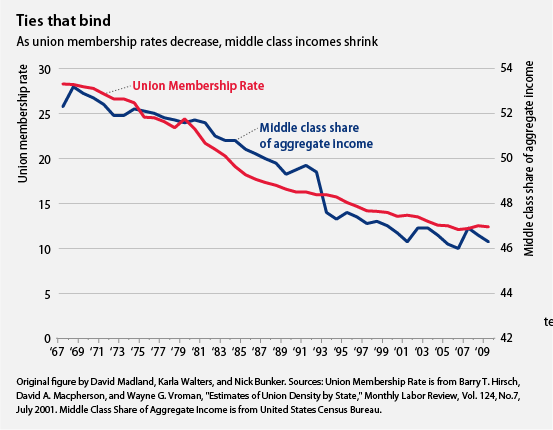
Although I’ve oftentimes heard the right demonize unions as dangerous to the delicate fabric of a free market, and oftentimes advocate enacting legislation to curb their power, there is no question the decrease in union membership has had a direct effect on the concentration of wealth in the United States and the middle class share of aggregate income. Here is are the results that were found by Karla Waters and David Madland of the at the Center for American Progress (CAP):
Now, before I get to the credit illusion, which is likely the culprit, first we have to dispel a few arguments against the stagnation of real wages in the United States – three of them specifically I want to talk about.
Q: Well, maybe workers’ productivity has not increased and their real wages are a direct result of a stagnation in their output? This cannot be true, hourly outputs per workers have actually been steadily increasingThis is based on information from the Bureau of Labor Statistics and Bureau of Economic Analysis; there is indeed a growing gap between output and real wages:
Q: The average income per household has gone up, isn’t that inconsistent in the stagnation of real wages? 
No, it is not. The Second Wave of feminism, which started in the early 60s, brought many more women to the workforce. It’s not that the workers are bringing more real income home, it’s that more people are working in the household. In an article in the journal article by Rebecca A. Clay of the American Psychological Association:

In 1940, according to the Employment Policy Foundation’s Center for Work and Family Balance, 66 percent of working households consisted of single-earner married couples. By 2000, that percentage had dropped to less than 25 percent. By 2030, the center estimates, a mere 17 percent of households will conform to the traditional “Ozzie and Harriet” model.

It is this phenomenon that has caused an increase in average income per household – there are now many more new sources income per family, but that doesn’t necessarily tell us anything about the average real wage for each individual bringing it home.

Q: You are not adding benefits to the real wage. The Bureau of Labor statistics has shown there has been a upward trend in real compensation per hour since the 1940s. Does this not explain the stagnation of wages?

It is true there has been a steady increase of real compensation (wages + benefits) per hour, below is a graph taken from the Bureau of Labor Statistics;

However, we have to look at this data with the increase in workers’ output rather than by itself. Since the year 2000, there has been especially a disconnect between real compensation per hour and output.
But this disconnect in average hourly compensation and productivity started far before the 00s; it actually began in the late 70s and got progressively worse since the Reagan years. Below is a graph from the Economic Policy Institute;
And although this graph does not show the growing gap between productivity and average hourly compensation since ’07, it has gotten much worse since then. So yes, average hourly compensation has been increasing but not as nearly as the same rate as productivity has.
————————————————————————————————————————————-
Now, for the topic of this post which may actually be shorter than the background information; Why aren’t the workers mobilizing and demanding higher wages as they did in the first half of the 20th century? There are many reasons; one being the destruction of unionism during the Reagan years and another being the of spending money you don’t actually have; the illusion of credit. Ever since real wages have become stagnant and the sharp decline of unionization in the 80s, there has been a sharp increase in household debt in the United States, which actually dissuades workers from demanding higher wages in some respects. It is this exploitative dichotomy that has kept corporate profits high and wages low; all in the guise of “buy now, pay later!” and ‘economic growth.
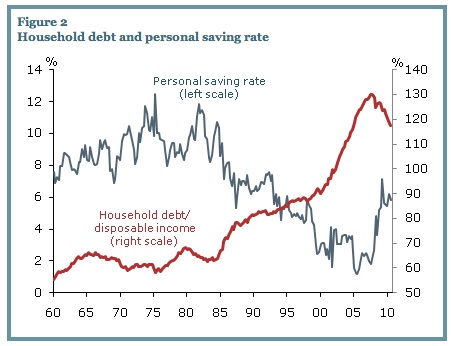
Below is a graph of household debt versus persona savings taken from ‘The Basis Point,’ a blog by mortgage banker Julian Hebron:
Why is the middle class shrinking and being anesthetized by credit? It is this type of behavior that drives society outside of its means and gives it working class families the false perception that their wages are increases; maybe nominally they are, which is deceptive in itself, but the main hurdle we must overcome is realizing the distraction of mass consumption by credit going forward. This requires questioning this entire system which has, for the most part, become based on credit and money yet to be paid. I highly fear the collapse of this ‘credit culture’ and the shaky foundation it is built on; And perhaps worst of all, we are unjustly condemning future posterity to debt bondage. What happened during the crisis of 2008 we may find to become a staple in the modern 21st century economic model; and since debt wasn’t properly liquidated, worse may be yet to come. The functionality of such an illusionary market method I am highly skeptical of, and its outcome will most definitely hurt the current mainstream liberal capitalist model.

The United States is often credited with reaching global economic status with free trade; that laissez faire capitalism and open trade with all nations brought us to modernity.

In actuality though, protectionism was vital in establishing American economic dominance and hegemony. The American System first promulgated by Henry Clay was critical of the British variant of economic thought and advocated high tariffs, a central bank, and federal subsidization of internal improvements (i.e canals, schooling, roads) amongst other things. It was built on Hamiltonian principles and the infant industry argument – that smaller industries must be protected from larger foreign competitors because they do not have the monetary means to compete.

Usually this put regional interests at end and created a bitter American divide – the North wanted high tariffs and subsidization and the South wanted complete free trade to be able to sell its goods (predominately cotton) to Britain and other foreign markets. It was one of the main causes of the Civil War; the clash of economic ideologies. South’s dependence on foreign markets was so strong that it firmly believed it could fully sustain itself without the North’s industry. The “King Cotton”ideology was used as a slogan to convince Southern public opinion; Southern legislatures promoted the message that since Britain’s and France’s dependence on Southern cotton for their textile mills was so strong, they would be forced to aid them in their struggle of secession. As the Union began blocking Southern seaports, this rallying call proved to be unfounded – foreign markets just found elsewhere to purchase cotton. The British Empire turned back to its colonies for cotton markets. India increased its cotton production by 700% and Egypt did likewise. The South was severely crippled and took many decades to recover. In addition, their laissez faire ideology was downgraded. The Republican (former Whig) American System became the dominant school of economic thought.

Average tariffs percentages were at their highest from 1865 – 1900; when the United States underwent its second Industrial Revolution. Despite the predictions of the powers of Europe, who believed the American Experiment would never recuperate from the Civil War, the United States underwent the one of the greatest economic growth periods in its history and established itself as a great power and then ultimately, much later, as a superpower. The Gilded Age ensued, which was arguable one of the most corporate-concentrated periods of power in U.S history; where the pervading ideology was that the wealthy were the “best of society” and the poor “did not work hard enough.” It was this concept that gave rise to the illusion of the American Dream and dissuaded the working class from mobilizing, in some respects. It worked in the interests of the wealthy most definitely.


But aside from that, in looking at today’s economic situation; why are we imposing free trade on other developing nations if we did not prosper from it ourselves when we were emerging as a power? The IMF and its associate organizations parade around promoting free trade and pressuring other nations to open to foreign capital only to further fill the pockets of the Western ruling class, and further impoverishing those not in high positions of power.


In South America, locals have been exploited for over a century by foreign ownership of land. Many of the legislatures have been complicit with the policies of the United States and the West and allowed for large corporate entities to buy out land; usually unused and to save for “later use.” Is this the benefit of free trade? The disproportionate ownership of global assets by Western powers? To make matters worse, a failure to allow foreign capital can have disastrous consequences. Many Latin American countries had coups staged, usually led by American interests, to halt any redistributing of land to the peasants. It is apparent that the First World depends on the Third World’s impoverished state to maintain their hegemony and economic superiority; they want these impoverished nations to remain dependent on their capital and investment. Well-calculated and planned underdevelopment, as its called.


But it seems that the leftist streak in Latin America may be changing this, hopefully soon. Some Latin American countries have already enacted legislation to redistribute unused private land to the poor, such as Hugo Chavez’s Plan Zamora in Venezuela. As of now, much of Latin American land remains in the hands of foreign investors. In Uruguay, the 2000 census showed that 17 percent of its arable land was foreign-owned, but it is predicted to be 20 to 30 percent today.  In Brazil, the Brazilian Institute for Colonization and Agrarian Reform estimates that 4.5 million hectares are owned by foreigners – but this figure is low and it may be twice as large, according to government officials. Argentinian authorities place its national estimates at 17 million hectares, about 10 percent of Argentinian territory, and about half of all arable land.
Moreover, sometimes when the land is returned back to “local hands” they’re heavily concentrated. The Landless Worker’s Movement in Brazil estimates, according to 1996 census records, that just 3% of the populations owns two-thirds of all arable land in Brazil. This only disempowers the majority and furthers economic inequality. According to World Development Indicators [2000] 10% of the population owns 47.6% of the wealth in Brazil. A study done by the Instituto de Pesquisa Econômica Aplicada (Institute of Applied Economic Research or IPEA) paints a even grimer picture “…in São Paulo the wealthiest 10% had 73.4% of while in Rio they retained 62.9% and in Salvador 67%.” A product of unequal land distribution caused by free trade and neo-colonialism, it seems.
The moral of the story; modern free trade is not fair trade. Business clusters that congregate around areas of high GDP are inherently exploitative of poorer regions, taking their land disproportionately. The last things these emerging nations want is foreign capital owning their assets and preventing them from prospering. This forced underdevelopment is imposed through laissez faire legislation, and kept in place by multiple transnational organizations that preach the same ideology. It is dangerous to the self-determination of peoples and their long-term prosperity. It is exploitative by nature, but it seems that some free market fundamentalists just cannot abandon their distorted dream. And then their obscurities are imposed on the rest of us, with disastrous global economic consequences.

More info on the land crisis of Latin American can be found here and here. Statistics and general info on Brazil’s widening wealth gap and poverty crisis can be found here.

Sometimes in the heat of revolutionary change, unspeakable atrocities are committed. Individuals look back in horror at what was inflicted and are unable to comprehend how citizens could go into such a collective state of irrationality. This societal dilemma is called an issue of anomie, which is described as a state of normlessness; where there is a rejection of self-regulatory values and any distinction between right and wrong, for the moment, become obsolete.

David Émile Durkheim, one of the fathers of modern sociology, coined the term ‘anomie’ in 1897 in his book ‘Suicide’ and describes it as a “a rule that is a lack of a rule.” A society can become anomic for a variety of reasons, but it is always preceded by a dissatisfaction with the current set of affairs. In essence, the people’s will to change the old order overcomes their rational instincts and makes them primitive peoples; regressing them from their modern consciousness. It is this phenomenon that is perhaps an obstacle to major revolutionary change, if done too hastily; since people loose their moral senses, their ability to recognize an emerging despotism all the more diminishes. This can have devastating consequences to the society after the initial short-lived euphoria of change.

One prevalent detailed precursor to ‘collective anomie’ is distorted idealism. The German Romantic author, Jean Paul, called this relationship of the mind and earth Weltschmerz – the grim understanding that the demands of the mind cannot be met in the physical world and that one’s weaknesses are a direct result of his relationship with the cruelty of what he witnesses and experiences. There are seemingly two dark paths that can follow; either the individual enters a state of escapist mentality and seclusion or develops an anomic response that renders him incapable of self-regulating his values. The former is much less socially destructive, since it is individualistic, and is much more prevalent; it is known as Hikikimori in psychological studies and oftentimes is caused by post-industrialism and its implications. It is especially present in modern day Japan, given the origin of the word itself; affecting about 3.6 million.

The anomic response to Weltschmerz holds a much greater societal cost. Although individual anomie is dubbed “sociopathic,” collective anomie is much more radical; it is the destruction of norms and values – and seemingly, for that time being, the destruction of morality. This deregulation of morals is often seen in war and violent struggles. It was present in the Yugoslav Wars, where Serbian soldiers in newly declared states of Croatia and the Bosnia would massacre citizens of non-Serbian ethnicity – for little reason other than ethic cleansing. A complex dilemma arises when you examine their actions; where did their moral consciousness go, and how could these seemingly ‘civilized’ peoples engage in such irrational violence?

Oftentimes, when individuals are given authority they feel inclined to maximize their power; the Serbian military was in a position of dominance, and they felt they needed to fully exert their power, no matter the ethical implications, for their ‘nationalistic common good.’ They had no limits; they were in a state of anomie. And moreover, war usually causes irrationality in the soldiers themselves, affecting their decision-making and their state of mind. It drives soldiers to do inexplicable acts – some so heinous they’re difficult to comprehend. In Bosnia during the Yugoslav War, rape was used as ‘an instrument of terror’ by the Serbian-Bosnians. The victims were usually Bosniaks (Bosnian Muslims) of the region. It illustrated a total suspension of ethics and is difficult even to describe in words. Young Bosnian girls were sold and passed around in predominately Serbian infantry lines for rape, torture, and sometimes death – the majority of this happening the region of Foča in Bosnia & Herzegovina. There were specific camps designated for rape and torture, driven by religious and ethnic hatred. Young females were systematically brought to the camps, raped & tortured, and traded to other soldiers for money or just general ‘enjoyment.’ In the submitted “Seventh Report on War Crimes in the Former Yugoslavia: Part II” the atrocities are described in grim detail:

“Day and night, soldiers came to the house taking two to three women at a time. They were four to five guards at all times, all local Foča Serbs. The woman knew the rapes would begin when ‘Mars na Drinu’ was played over the loudspeaker of the main mosque..” 

“..While ‘Mars na Drinu’ was playing, the women were ordered to strip and soldiers entered the homes taking the ones they wanted. The age of women taken ranged from 12 to 60. Frequently the soldiers would seek out mother and daughter combinations. Many of the women were severely beaten during the rapes.”

The song ‘Mars na Drinu’ was a Serbian-Chetnik patriot song that was banned under Tito in socialist Yugoslavia. To illustrate the ethnic dimension even further, the report goes in more personal detail of the rapes:

“While the witness was being raped, her rapist told her, ‘You should have already left this town. We’ll make you have Serbian babies who will be Christians.’ Two soldiers raped her at that time; [And then] five soldiers raped the 18-year-old girl in full view of the witness.”

Now, the frightening question still remains; what caused these individuals to lose their sense of humanity? What desensitized them to the point of violence and rape? The collapse of their moral environment, their racially-idealist attempt to realize their nationalist goals, and the elimination of social values all contributed to their irrationality. They became submissive to ‘herd mentality’ that was formed on ‘rules that lack rules’ – there was no moral direction. It is this, I fear, that any form of disorganized violence could bring. This form of irrational collectivism is dangerous, and if any revolutionary change is brought it must be properly handled to prevent such a tragedy, in the true Aristotelian sense of the word, from happening.

*** 
You can read the this particular war crimes report in full here. Also, an interview of Seada Vranic, the author of ‘Breaking the Wall of Silence,’ can be found here. She is a renowned journalist who has covered the mass rape that occurred during the Bosnian War.

Today, while I was fidgeting around with the American flag, I kindly asked my youngest 6 year old brother to say the Pledge of Allegiance, not expecting much. He said it word for word and, despite irregular pauses between phrases, managed to recite it fully and was overly-content when he finished.

I then asked him what it meant, and I was sincerely surprised at his answer even though I should have known better; he didn’t have the slightest idea. He was just telling it as he was taught in school, without any any comprehension of what he was proudly repeating every morning in school.

Frankly, this is seemingly a product of – to borrow a word from the lexicon of Michael Parenti – Superpatriotism. He describes it in these words;


Superpatriots are those people who place national pride and American supremacy above every other public consideration, those who follow leaders uncritically, especially in their war policies abroad.

Parenti goes on to describe it ideologically in more detail;

The superpatriot’s America is a simplified ideological abstraction, an emotive symbol represented by other abstract symbols like the flag. It is the object of a faithlike devotion, unencumbered by honest history. For the superpatriot, those who do not share in this uncritical Americanism ought to go live in some other country.

Is the American school system raising a passive society of ‘Superpatriots?’ Although too young to understand ideological connotations and public policy or to form their own opinions, one of first lessons in elementary education is instilling vibrant nationalism, indulging them in American Exceptionalism,’ and learning the Pledge of Allegiance. This, to me, is nationalistic madness because it is this type of ideology that drives self-destructive policies and cultivates, either intentionally or not, a breed of obedience that is dangerous to civic duties and functions.

This you are either with or against us’ nationalist fervor is a true danger to a societal vigilance; if anything nationalism should be reasoned, discussed, and accepted voluntarily (if even that) at a certain coming of age, not imposed on the feeblest of minds.

Moreover, why are we replacing skepticism with blind love of the state? As Howard Zinn said: “Dissent is the greatest form of patriotism!” 

In modern history courses, it is implied the age of colonialism ended after the decolonization of Africa in the years after WW2. After the mass exploitation of indigenous persons, the destruction of their cultures, and the genocide of their peoples – the Western powers are sorry for what they’ve done, and they’ve shown their gratitude by leaving them to their own. The “White Man’s Burden” is over; we’ve changed.

But what do we make of the humanitarian wars and the imposed economic globalization through international institutions? Is this something to embrace, or is it rather neocolonialism “with a human face?

If there is one thing we can learn from the tragedy of 19th and 20th century colonialism is that the interests are seldom explicitly stated. It is illustrated as the noblest of causes; it was the duty of ‘civilized’ to help those less fortunate and rid them of their immoral cultures. It is this relationship between the colony and the colonizers that is seemingly most dangerous, and established cultural hegemony [a term borrowed from Anton Gramsci’s writings] on those under occupation, making them disillusioned of what the future held. In of itself, this creates an atmosphere of implied prejudice and dependence that severely dismantles the cultural balance and solidarity among the peoples of that area. On a tangible level it strips them of their natural resources, impoverishing them, and leaving them to wallow in their suffering.

On the topic of the noble portrayal of colonialism – each Empire had their own distinct form of doublespeak used for garnering support. For the French and Portuguese it was the “civilizing mission,” all in effort to tame the ‘backward people’ in order to forcibly assimilate them into the social mores of the respective empire. For the Americans, and the British also, it was predominately the “White Man’s Burden” based on a poem by Rudyard Kipling which portrayed the imperialism as a noble enterprise and seemingly divinely sanctioned. For other empires, their reasons were almost explicitly nationalistic with little ‘noble’ justification. The German and Italian Empires both wanted their “place in the sun,” especially Germany after Kaiser Wilhelm II’s rise to power and his doctrine of Weltpolitk. The Japanese empire was the only non-western imperialistic power and they based their doctrine on anti-western ideals and nationalism; the foreign policy of the Shōwa period was dominated by the concept of the “Greater East Asia Co-Prosperity Sphere” which attempted to create a domineering Japanese presence in Eastern Asia. It’s underlying motive was similar to that of the American ideology of “Manifest Destiny” and many Japanese felt it was self-evident they would expand after the many wars Japan engaged in, particularly with China and Russia. 

Not surprisingly so, much of the language used during the apex of what I call ‘classical modern colonialism’ is still prevalent today, albeit in a different more obscure context. The public reasons for militarization and dominance have changed and the functions of a physical empire have exhausted their use; however, the motivations for a commercial one are still very present in policy – and the reasoning may very well be very much the same; It is the public admission that we’re “civilizing” them, but not with culture this time [as least not directly], but rather with “democracy” and “liberal capitalism.” This was the justification for American-backed coups d’état of the 20th century, to eliminate any threat to American hegemony on the global stage, which was then communism. It was driven by fear and perhaps even more fundamentally ‘American Exceptionalism’ of which is staple of any imperialistic power. The reality of the Iraq War, the United States’ current occupation of Afghanistan, and the drone strikes all over the Middle East only enforces that this concept is still very fresh in the minds of American policymakers. It seems Americans have already forgot the tragedy of Vietnam, which they swore they would never allow to happen again. Noam Chomsky described the danger of this anomaly as such:

“Historical amnesia is a dangerous phenomenon, not only because it undermines moral & intellectual integrity, but also because it lays the groundwork for crimes that lie ahead..”

And in this respect, I cannot agree more. Historical amnesia and an ignorant public is always benefit to the policymakers – it is institutionalized ignorance and a product of exactly how the system was created to function in an effort to engineer a passive social order, and the assumed ‘benevolence’ of today’s major powers is only the tip of the iceberg sadly enough.

Aside from the United States, Western Europe is engaging in very similar neo-imperial activity to maintain at least some form of economic, political, or military control on the former colonies. France’s policy of Françafrique, which was once hailed to be a mutually beneficial relationship, is inherently exploitative. France’s supporting, and subtle funding, of resource-rich dictatorships such as that of the Democratic Republic of Congo [dictatorship until 1997] and Gabon [whose dictator died in 2009, but his son is now in power] are dissuading and rendering it near impossible for the native people there to establish their own system. This populist disconnect from policy and reality is a feature created by the former colonizers and was mostly promulgated during the Cold War, with the establishment of anti-Communist dictatorships, but is still very much a systemic staple of Western foreign policy today; all done in the name of safety, democracy, and ‘moral doctrines.

Although current French President Sarkozy has attempted to distance himself from Françafrique, it’s implications are still felt and still being pursued. France has been in more military operations in the past few years than it has been in the last 50; its intervention in its former colony Ivory Coast, its intervention in the Libyan Civil War (which it conducted before the emergency meeting of Western powers in Paris), its co-opting [with the U.S primarily] of the 2004 Haitian coup d’état of former president Jean-Bertrand Aristide, its troop deployment into the former French colony of Chad, and its military involvement in the Afghanistan War. All of these, claimed to be purely humanitarian wars, have much of the criteria of a neo-colonial mentality – and aims at establishing French (or Western) dominance in these regions of the world.

And perhaps equally commercially imperialistic is the World Bank and the WTO, where the World Bank gives loans to autocratic regimes in the Third World, only to see that money go to waste and then asking the WTO to demand repayments; which always comes in the form of severe cuts for programs necessary for those not in power. It is this dynamic that is exploitative and ultimately prevents these nations from ever reaching real global status, among other things.

Seemingly so, ignorance always benefits the state – and that certainly holds true in this case. The disillusionment of the public on foreign policy is rather frightening, and the imperial trends will continue to be cyclic and unbroken until it is realized. I take an anti-imperialist stance from an ethical, philosophical, and morally-pragmatic perspective; because the self-determination of peoples in realizing their own destinies cannot be undermined, no matter how elusively humble the cause or how great the safety that is promised thereafter.

YesterYear Once More

Life as it was reported back then

Victor Serge's Ghost

"One must range oneself actively against everything that diminishes man, and involve oneself in all struggles which tend to liberate and enlarge him"

Collecting Russian Art

20th century Russian art and its uniqueness

Communist League Tampa

proletarians of the world, unite!

Mosul Eye

To Put Mosul on the Global Map

Uglytruth-Thailand

Thai politics

Yanis Varoufakis

THOUGHTS FOR THE POST-2008 WORLD

Fractal Ontology

refracting theory: politics, cybernetics, philosophy

The Disorder Of Things

For the Relentless Criticism of All Existing Conditions Since 2010

Valentino's blog

A blog about visual arts (well, mostly...)

Negative Catallactics

institutional political economy, social ontology, neopragmatism, critical theory

rheomode

a research practice working at the intersection of architecture, technology, art and ecological pedagogy

Paths to Utopia

scattered reflections on politics for our time

Evvycology

It's Evelyn, It's Ecology, all in one convenient package

Idiot Joy Showland

This is why I hate intellectuals

All that is Solid for Glenn Rikowski

All that is Solid ... is a radical blog that seeks to promote a future beyond capital's social universe. "All that is solid melts into air" (Karl Marx and Friedrich Engels, 'The Communist Manifesto', 1848).

Symptomatic Commentary

Notes, Interviews, and Commentary on Art, Education, Poetics, and Culture

The View East

Central and Eastern Europe, Past and Present.

Uneven And Combined Development

theorising the international

Bezbozhnik - безбожник

On anti-religious propaganda in the early USSR, with some disgressions on the Russian Soul.

Nationalism Studies

Monitoring the Changing World

Old Woman on a Bicycle

My Photography, Mostly

Sráid Marx

An Irish Marxist Blog

Pedagogy & the Inhumanities

Pedagogic nihilism fights a windmill battle against international capital

Peter Marcuse's Blog

Critical planning and other thoughts

communists in situ

leberwurst proletariat

People and Nature

Some socialist ideas about society, the earth and their interaction

Posthegemony

Something always escapes!

New Historical Express

(Formerly Hatful of History)

RedneckRevolt Blog

Dave Strano | Anti-fascist | Anti-racist | Gunslinger

Words As Intervention

Anthropological Reflections

"And you shall teach this to your children"

A Jewish family's journey through Palestine

BINARYTHIS

EVERYTHING YOU ALWAYS WANTED TO KNOW ABOUT GENDER BUT WERE TOO AFRAID TO ASK

The Renaissance Mathematicus

Just another WordPress.com weblog

GraecoMuse

ἓν οἶδα ὅτι οὐδὲν οἶδα